Introduction
Falls from ladders and scaffolding remain among the deadliest hazards in construction. In 2024 alone, 844 fatal falls, slips, and trips occurred, with falls from heights over 30 feet accounting for 10.8% of these fatalities. Placing a step ladder on top of scaffolding to gain additional height is a practice that happens far more often than safety professionals expect—and the consequences at combined heights are severe.
A flexible scaffold platform doesn't behave like solid ground. Add a step ladder on top, and the dynamic forces of a climbing worker can shift, tip, or collapse the entire setup—often with no warning.
That's precisely why OSHA addressed this practice directly under 29 CFR 1926.451(f)(15). Violations carry citations, fines, and stop-work orders. This guide walks through those rules, the real risks, and what to do instead.
TL;DR
- OSHA prohibits placing step ladders on scaffolding under §1926.451(f)(15), with a narrow exception for large area scaffolds only
- Step ladders are self-supporting with no lean point, making them especially unstable on scaffold platforms
- The large area scaffold exception requires four conditions: no sideways thrust, locked platform units, both ladder legs on the same platform, and legs secured against slipping
- Adding another scaffold level is always the safer alternative to stacking a ladder on top
- Extension or combination ladders used near scaffolding on uneven ground require proper leveling to stay stable
Is It Safe to Put a Step Ladder on Scaffolding?
Scaffolding platforms are elevated, often narrow, and may flex under load. Placing a step ladder on them creates compound instability where any shift at platform level is amplified at the top of the ladder, sharply increasing fall risk.
Why Step Ladders Are Particularly Problematic
Step ladders present unique dangers compared to other portable ladders:
- Spread legs catch on platform edges or gaps between planks
- No fixed lean point against the scaffold structure (unlike extension ladders)
- No reliable anchor point against the scaffold frame
- Only three legs typically experience significant ground reaction force at any instant, even when all four feet are positioned
When placed on flexible scaffold planks, this unequal force distribution causes platform deflection, leading to tipping or slide-outs.
The Height-Multiplier Risk
That instability doesn't just cause a fall — it determines how far you fall.
If a worker falls from a step ladder placed on a scaffold platform that's already 10 feet off the ground, the actual fall distance can reach 15-20+ feet. According to the Center for Construction Research and Training, 17.9% of fatal falls occurred from 11-15 feet, 14.7% from 16-20 feet, and 17.8% from over 30 feet. Stacking a ladder on scaffold pushes workers directly into these fatal-fall ranges before they've climbed a single rung.
A NIOSH FACE report illustrates this exact hazard: A 55-year-old drywall finisher died after falling 22 feet. He had placed an 8-foot wooden stepladder on top of a 17-foot mobile scaffold. The casters were unlocked. When his weight shifted at the ladder's base, the scaffold rolled — and he fell headfirst.
What OSHA Regulations Say About Ladders on Scaffolding
OSHA 29 CFR 1926.451(f)(15) states: "Ladders shall not be used on scaffolds to increase the working level height of employees..." with only one exception for large area scaffolds.
What Is a Large Area Scaffold?
OSHA defines a large area scaffold as "a scaffold erected over substantially the entire work area. For example: a scaffold erected over the entire floor area of a room." Most jobsite scaffolding—tube-and-coupler bay scaffolds, mobile towers, pump jack scaffolds—does NOT meet this definition.
The Four Mandatory OSHA Conditions
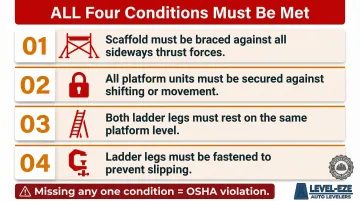
When using a ladder on a qualifying large area scaffold, ALL four conditions must be satisfied:
- If the ladder rests against a structure outside the scaffold, the scaffold must be braced against any sideways thrust the ladder creates
- All platform units must be secured to the scaffold to prevent shifting under load
- Both ladder legs must rest on the same platform, or the setup must otherwise account for unequal platform deflection
- Ladder legs must be fastened to prevent slipping or displacement during use
Enforcement and Penalties
Miss any of those four conditions and you're looking at a direct OSHA violation under §1926.451(f)(15). In FY 2024, Fall Protection, Ladders, and Scaffolding were all among the top 10 most frequently cited standards.
Maximum penalties (effective January 15, 2025):
- Serious violations: $16,550 per violation
- Willful or repeated violations: $165,514 per violation
- Failure to abate: $16,550 per day beyond the abatement date
Competent Person Requirement
OSHA standards require a competent person to assess scaffold access and fall protection feasibility before any non-standard access method is used. Both Subpart L (Scaffolds) and Subpart X (Ladders) apply simultaneously. Workers and supervisors on the same jobsite must meet the requirements of both standards.
Safety Requirements If a Ladder Must Be Used on a Scaffold
Examine the Platform First
Before placing any ladder, a competent person must fully inspect the scaffold:
- Verify it qualifies as a large area scaffold erected over substantially the entire work area
- Confirm guardrails meet or exceed OSHA requirements on all open sides (toprails 38–45 inches high)
- Confirm the structure was erected per §1926 Subpart L requirements
- Check fall protection gaps — if the worker's highest standing level plus 6 feet exceeds the distance to the nearest platform edge, increase guardrail height or add supplemental fall protection
Set Up the Ladder Correctly
Proper setup prevents the two most common failure modes: tip-overs and sliding. Address platform positioning and securing as separate steps.
Platform positioning:
- Place both legs on the same scaffold platform section — never spanning two boards or a platform gap
- Unequal deflection across separate boards is a leading cause of ladder tip-overs at height
Securing the ladder:
- Physically secure all legs before use using rope lashings, mechanical clamps, or purpose-built restraints
- Unsecured legs can slide or get kicked out during normal climbing activity
Scaffold bracing:
- Brace or tie off the scaffold to resist lateral force before the ladder goes up
- This is especially critical when the ladder leans toward a structure separate from the scaffold frame
Fall Protection Requirements
Once setup is confirmed, verify that fall protection covers every elevation the worker will reach on the ladder.
Guardrails are required on all open sides of the platform. If the worker's standing level on the ladder rises above guardrail height, a personal fall arrest system — harness and lifeline — becomes mandatory.
Anchor point selection matters as much as the harness itself:
- Keep the lifeline anchor independent of the ladder and of any scaffold component that could shift under load
- Vertical lifelines must attach to a fixed safe point of anchorage per §1926.451(g)(3)(i)
Common Safety Mistakes to Avoid
Three mistakes come up repeatedly on jobsites—and each one can turn a routine task into a serious incident.
Assuming the large area exception applies. Most jobsite scaffolding doesn't qualify. The exception covers only scaffolds erected over substantially the entire work area (think: an entire floor). Tube-and-coupler bay scaffolds, mobile towers, and pump jack scaffolds rarely meet that threshold—yet workers routinely assume otherwise.
Skipping leg securement on the platform. Scaffold planks flex, shift, and vibrate under combined load. A minor wobble that looks harmless at ground level can become a full-height fall when the ladder legs aren't anchored. "Solid enough" isn't a standard—physical securement is.
Ignoring the fall protection calculation. OSHA's construction threshold is 6 feet. Combined ladder-plus-scaffold height almost always crosses it. Once a worker climbs above guardrail height on the ladder, a body harness must be in the plan—regardless of whether the combined height "feels" significant.
Safer Alternatives to Placing a Step Ladder on Scaffolding
Add an Additional Scaffold Level
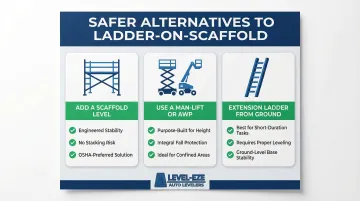
The preferred and OSHA-recommended solution is to add an additional scaffold level. If the existing scaffold height is insufficient, the correct fix is to raise the scaffold structure rather than stack equipment on top of it. This maintains the engineered stability of the system and avoids compounded fall risk.
Use a Man-Lift or Aerial Work Platform
When the additional height needed exceeds what the scaffold can safely provide, or when the work area is too confined to expand the scaffold, use a man-lift or aerial work platform (AWP). These systems are purpose-built for elevated work and include integral fall protection.
Use a Properly Set-Up Extension or Combination Ladder from the Ground
When the task is short-duration and reaching from ground level is feasible, a properly set-up extension or combination ladder is a practical alternative. Construction sites frequently have uneven ground surfaces, making base stability a critical factor.
An automatic ladder leveler like Level-EZE addresses this directly. It ensures both ladder legs make solid, equal contact with the surface — no shimming, blocking, or manual adjustment required. Key specs:
- Adjusts automatically up to 9.5 inches for height differences
- Locks with as little as 9 pounds of weight
- Adds approximately four inches to the ladder base width
- Handles slopes, steps, curbs, and uneven terrain common on job sites
Frequently Asked Questions
Can you use a step ladder on scaffolding?
OSHA generally prohibits this practice under §1926.451(f)(15), with a narrow exception only for large area scaffolds where all four OSHA safety conditions are satisfied. Step ladders are particularly risky due to their self-supporting design and lack of a fixed lean point.
Does OSHA allow placing a ladder on scaffolding?
OSHA prohibits ladders on scaffolds to increase working height except on large area scaffolds. Even then, four conditions must all be met: the scaffold is secured against sideways thrust, platform units are locked down, ladder legs are on the same platform, and legs are secured against slipping.
Should ladders be used on scaffolding?
The industry best practice—and OSHA's preferred solution—is to add a scaffold level rather than introduce a ladder onto the platform. This maintains the engineered stability of the system and avoids the compounded fall risk.
How high should a ladder extend above a scaffold?
When a ladder is used to access a scaffold platform (not placed on top of it for height), it should extend at least 3 feet above the platform landing per OSHA ladder standards, giving workers a safe handhold when transitioning on and off the ladder.
What is the 4-to-1 ladder rule and does it apply to scaffolding?
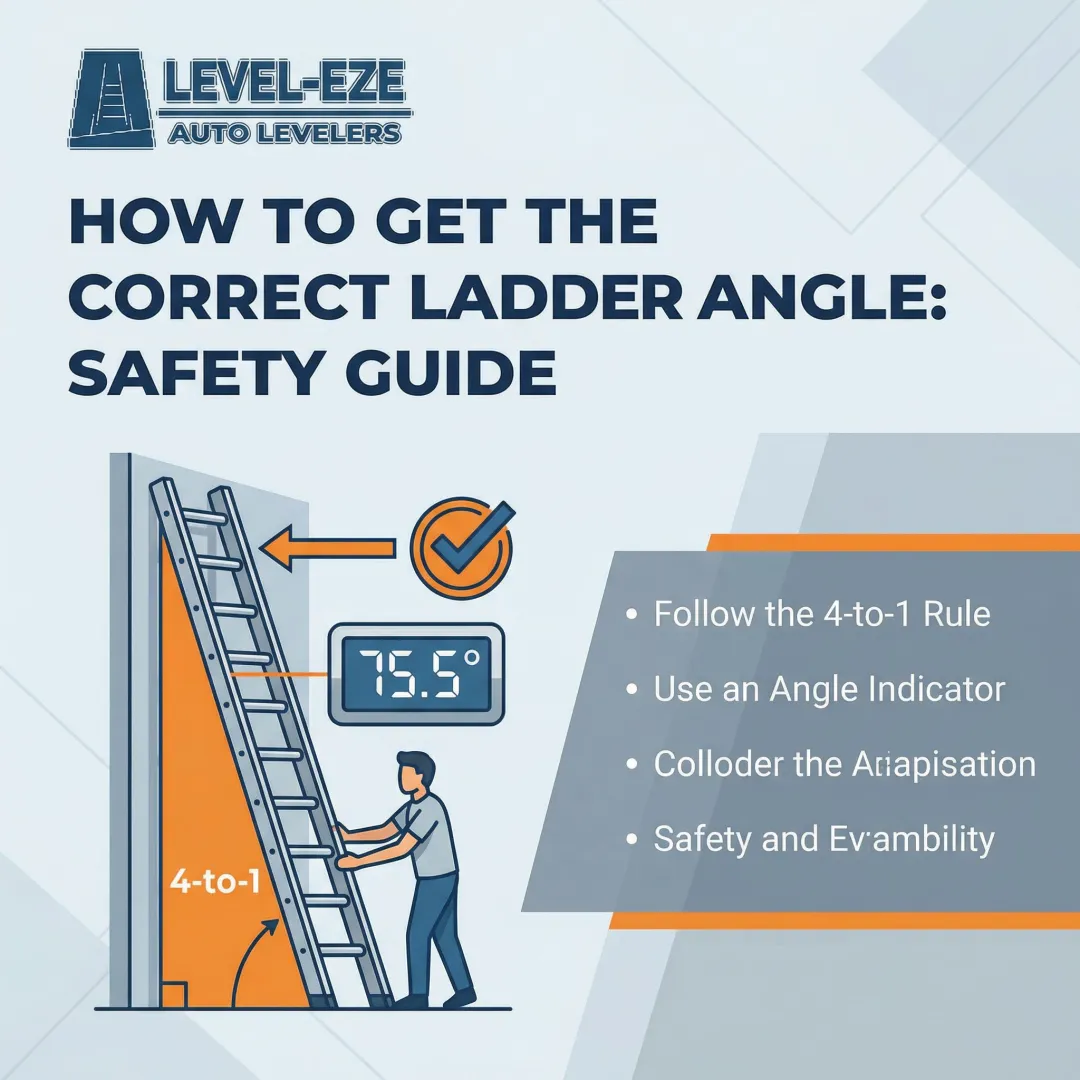
The 4-to-1 rule requires the ladder base to be set 1 foot out for every 4 feet of height. It applies to portable leaning ladders accessing scaffolding from the ground — not to step ladders, which are self-supporting. Placing a step ladder on scaffolding raises entirely different stability concerns governed by §1926.451(f)(15).
What type of ladder should be used with scaffolding?
Scaffolding systems use hook-on or attachable ladders designed for the scaffold type (per §1926.451(e)(2)), or integrated internal climbing rungs. Freestanding step ladders and general-purpose portable ladders placed on the platform are not a substitute for these dedicated access solutions.