Introduction
In 2020, ladders were the primary source of 161 fatal work injuries and 22,710 nonfatal injuries requiring days away from work, according to the Bureau of Labor Statistics. These aren't just statistics—they represent lost workdays, workers' compensation claims averaging $54,499 per incident, project delays, and legal liability for employers who fail to enforce safe ladder practices.
Approximately 40% of those incidents trace back to one mistake: the ladder slides out at the base because it was set at the wrong angle. That's not a freak accident — it's a setup error, and it's entirely preventable. Getting the angle right is one of the simplest things you can do to keep yourself and your crew off the injury report.
TL;DR
- Leaning and extension ladders require a 75.5-degree angle from horizontal, which the 4-to-1 rule helps you set correctly
- For every 4 feet of ladder height, move the base 1 foot away from the wall
- OSHA and ANSI standards both mandate this positioning for portable non-self-supporting ladders
- Firm, level, non-slip surfaces are essential at the base — uneven terrain throws off your angle even when you've measured correctly
- Use the arm-reach test for fast on-site confirmation that your angle is correct — no tools required
What Is the Correct Ladder Angle and Why It Matters
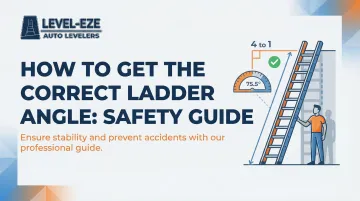
Extension and single (non-self-supporting) ladders should be erected at 75.5 degrees from the horizontal. This is the standardized pitch recognized by ANSI standards for portable extension ladders and required by OSHA regulations.
Two Ways to Express the Same Angle
This angle is expressed in two ways that describe the same setup:
- The 4-to-1 ratio rule: Base distance equals ¼ of the ladder's working length
- The 75.5-degree rule: The actual angle measurement from horizontal
The 4-to-1 ratio is the easier method to apply in the field, as it requires only basic measurement rather than a protractor or angle finder.
Both ANSI A14.2 standards and OSHA regulations (29 CFR 1926.1053) require this angle for portable extension ladders — so knowing how to set it correctly in the field is non-negotiable.
How to Position a Ladder at the Correct Angle
Five methods can help you nail the correct angle every time — from quick field checks to OSHA-mandated requirements. Start with the 4-to-1 rule as your baseline, then use the supporting checks to confirm it on-site.
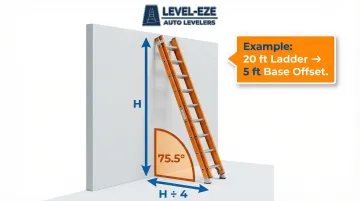
The 4-to-1 Rule Calculation
Follow these steps to apply the 4-to-1 rule:
- Measure or estimate the height the ladder will reach (working length)
- Divide by four to determine the base offset distance
- Place the ladder base that many feet away from the wall or upper support
Example: A 20-foot ladder requires a 5-foot base offset (20 ÷ 4 = 5).
The Arm-Reach Test
This quick no-tool field check takes seconds:
- Stand at the base of the ladder with feet against the ladder feet
- Extend your arms straight forward at shoulder height
- If your palms rest naturally on a rung at shoulder height without bending forward or backward, the ladder is at the correct angle
- If your palms land above or below shoulder height, adjust the base position in or out and retest before climbing
NIOSH Ladder Safety App
The National Institute for Occupational Safety and Health offers a free Ladder Safety App for iOS and Android devices. Place your phone on a rung, and the app uses the device's accelerometer to confirm whether the angle is correct through visual, sound, and vibration signals.
Built-In Angle Indicators
Certain extension ladders come with a bubble level or angle indicator mounted on the rail — you read it the same way you'd read a carpenter's level. These are a useful at-a-glance confirmation, but they're reference aids. Always set up using the 4-to-1 calculation first, then use the indicator to verify.
The 3-Foot Extension Rule
When the ladder provides access to a roof or elevated landing, a separate OSHA requirement comes into play. OSHA mandates that the top of the ladder extend at least 3 feet above the roofline or upper landing point. Factor this extension into the working length before calculating your 4-to-1 base distance — otherwise your base offset will be short.
Maintaining the Correct Angle: Surface, Environment, and Terrain
Why Ground Surface Affects Angle Accuracy
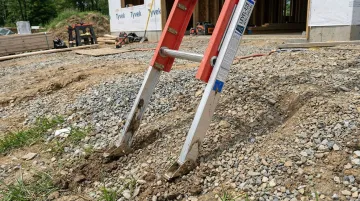
A ladder placed on soft, uneven, or sloped surfaces will shift from its set angle under load. Firm, level, non-slip ground is required for the 4-to-1 calculation to hold in practice.
Environmental Conditions That Compromise Stability
Several conditions reduce surface stability:
- Wet, icy, or oily ground reduces foot traction
- Soft soil allows feet to sink, changing the effective angle
- Muddy surfaces create unpredictable shifting under load
- Outdoor slopes (roadsides, lawns, job sites) create unequal leg support
Each condition changes the effective angle of the ladder relative to the ground, even if you initially set it correctly.
The Cross-Slope Problem
A ladder placed on a cross-slope (one side higher than the other) cannot safely hold a proper angle. One rail will be higher than the other, creating a lateral lean that increases side-tip risk regardless of the front-to-back angle.
Addressing Uneven Terrain Safely
Traditional leveling methods—digging out the ground, using wooden blocks, or leaning one foot on a curb—are unreliable and create new hazards. These makeshift solutions shift under load, introduce instability, and often require technicians to compromise their balance during setup.
Automatic ladder levelers eliminate these risks at the source. Level-EZE levelers automatically compensate for uneven surfaces — no manual balancing required. Technicians keep both feet on the ground and both hands on the ladder throughout setup. Trusted by safety professionals for over 25 years and compliant with ANSI standards for portable extension ladders, the device adjusts up to 9.5 inches of height differential and locks automatically when as little as 9 pounds of weight is applied.
Other Safety Practices That Support Correct Ladder Angle
Three Points of Contact
Maintain three points of contact at all times—both feet and one hand, or both hands and one foot. This keeps your center of gravity over the ladder; overreaching shifts your body weight laterally and can destabilize even a correctly angled setup.
Key reminders:
- Keep your belt buckle between the rails — never lean outside them
- Reposition the ladder rather than stretching to reach
- Descend and move the ladder if a task requires extended reach
Top-Securing Requirements
Wherever possible, tie off the top of the ladder to the structure. This prevents sideways movement and reduces the risk of angle drift if the ladder shifts underfoot.
Respect Weight Ratings
Never exceed the ladder's duty rating. Overloading generates forces beyond what the correct angle can safely manage, particularly at the base feet, and can cause structural failure or base slip-out. and can cause structural failure or base slip-out. Maintaining the right angle only works when the ladder operates within its rated load — both factors work together.
Common Ladder Angle Mistakes to Avoid
Three setup errors account for the majority of angle-related ladder accidents:
- Eyeballing the angle instead of measuring it
- Setting up on uneven ground without correcting it first
- Forcing an oversized ladder into a confined space at a shallow angle
Eyeballing the Angle
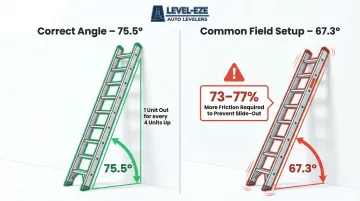
Skipping the 4-to-1 setup and guessing the angle is the most common error. A field study of 67 professional cable installers revealed an average actual setup angle of 67.3 degrees—significantly shallower than the required 75.5 degrees. Despite training, only 3 out of 67 participants applied formal methods in daily work.
At 67.3 degrees, the ladder requires 73-77% more friction at the base to prevent slide-out, sharply raising the risk of the ladder kicking out and collapsing forward.
Setting Up on Uneven Surfaces Without Addressing Them
The angle may appear correct when the ladder is empty, but the feet will shift under load. This is especially common on job sites where workers move quickly between tasks and skip the ground assessment.
As the climber ascends, their weight causes one foot to sink or shift — changing the angle mid-climb and triggering an unexpected slide-out or tip-over.
Forcing a Too-Long Ladder Into a Shallow Angle
In confined spaces, workers often over-flatten the ladder to clear a ceiling or overhang, which violates the 75.5-degree minimum. The shallow angle puts excessive outward force on the base, causing the ladder to kick out from the bottom.
Use a shorter ladder that fits the space at the correct angle — there's no safe workaround for a ladder that's too long for the setup.
Conclusion
The correct ladder angle is not a technicality—it is the physical foundation of every other ladder safety practice. Getting it wrong eliminates the benefit of all other precautions, from three-point contact to proper footwear.
Treat angle verification as a non-negotiable step before every climb. Consistent use of the 4-to-1 rule, combined with proper surface assessment, turns a critical safety check into second nature. On uneven or sloped terrain — where maintaining that angle gets harder — a ladder leveling accessory removes the guesswork entirely, letting you set the correct angle without dangerous balancing adjustments at the base.
Frequently Asked Questions
What angle should a ladder be put at?
Leaning and extension ladders should be positioned at 75.5 degrees from the horizontal, achieved by applying the 4-to-1 rule: place the base one foot out for every four feet of working height.
What is the OSHA standard for ladder angle?
OSHA requires portable non-self-supporting ladders to be set up so that the horizontal distance from the base to the wall equals one-quarter of the ladder's working length. This is equivalent to the 75.5-degree angle standard required under ANSI guidelines.
What is the 4-to-1 ladder rule?
The 4-to-1 rule is the practical formula for achieving the correct ladder angle: for every 4 feet of height the ladder reaches, the base must be placed 1 foot out from the wall or support surface.
How can I quickly check if my ladder is at the correct angle without tools?
Use the arm-reach test: stand at the base of the ladder with feet against the ladder feet, extend arms horizontally—if palms rest naturally on a rung at shoulder level without bending, the angle is correct.
What happens if a ladder is set at too steep or too shallow an angle?
A too-steep angle risks the top sliding or tipping backward. Too shallow puts excessive outward force on the base feet, causing the ladder to kick out forward. Both create dangerous fall conditions.
Can I use an extension ladder safely on uneven or sloped ground?
Uneven ground must be addressed before use. Makeshift fixes like stacked blocks are unreliable and dangerous. Purpose-built automatic ladder levelers — such as those made by Level-EZE — are the safest solution, letting you set the correct angle without dangerous improvisation.