Introduction
Stairs represent one of the most challenging environments for ladder work — uneven, stepped terrain disrupts standard ladder balance and frequently forces users into unsafe improvised setups. In 2020 alone, 161 fatal work injuries and 22,710 nonfatal workplace injuries resulted from ladders, with approximately 40% of ladder-related injuries caused by the ladder sliding out at the base due to incorrect setup.
Most ladders are designed for flat ground. Place one on stairs without the right technique or equipment and you get wobbling, overreaching, or worse.
This guide covers how to correctly set up and use an adjustable (articulating or multi-position) ladder on stairs: the right configuration, step-by-step setup, safe operation, and best practices that go beyond the manufacturer manual.
TL;DR
- Adjustable ladders work on stairs because each side telescopes independently — one leg sits higher, the other lower
- Inspect all hinge locks, slide locks, and feet before setup; ensure stair surfaces are dry and clear
- Set in A-frame position, extend each side to match its stair level, and lock all mechanisms before climbing
- Never reposition from the top — always descend, adjust, and re-verify stability
- For extension ladders on stairs, a ladder leveler like Level-EZE eliminates guesswork and reduces base-shift risk
When Should You Use an Adjustable Ladder on Stairs?
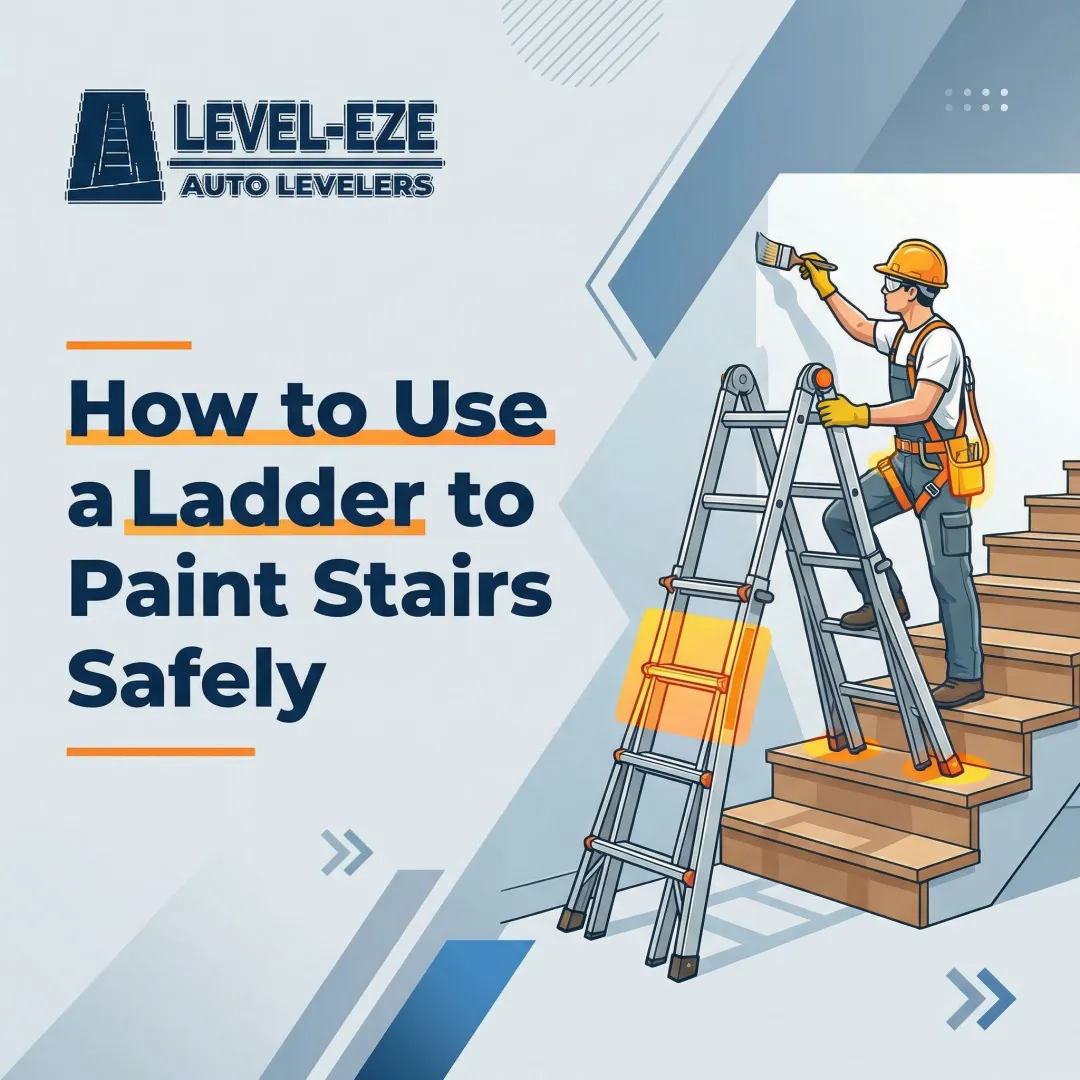
An adjustable ladder on stairs makes sense when your work area spans the height of a stairwell and a standard flat-ground setup won't reach. Common scenarios include:
- Painting a wall above a landing
- Reaching a high ceiling over a staircase
- Accessing a light fixture positioned above stairs
- Installing or servicing equipment mounted in stairwell spaces
Common Misuses:
- Placing a standard A-frame on two stair treads without independent leg adjustment (both legs must contact stable surfaces at different heights)
- Using an extension ladder leaned against the stairwell wall without leveling support
- Setting up any ladder on stairs where only one foot makes proper contact
Not every staircase is a good candidate, either. Adjustable ladders work best on standard straight staircases with treads deep enough to accommodate the ladder's feet. Carpeted, narrow, or spiral stairs may require additional precautions or different access equipment entirely.
What You Need Before Setting Up on Stairs
Gather these five things before your ladder touches a single stair tread:
- Owner's manual: Slide locks and hinge mechanisms vary by brand — confirm your model supports stair-use configurations before setup.
- Clear, dry treads: Remove or secure any rugs, carpet runners, and loose mats so the ladder's feet contact the hard tread surface directly.
- A spotter: Stairwell work is confined and requires frequent repositioning. A second person steadies the base and watches for foot clearance.
- Non-slip work footwear: Avoid soft-soled shoes or worn boot treads — grip matters on the rungs and when stepping on and off the stairs.
- A completed pre-use inspection: Check hinge locks, rung locks, and rubber feet for wear or damage. A minor defect on flat ground becomes a stability failure on uneven terrain.
How to Set Up and Use Your Adjustable Ladder on Stairs
Correct usage on stairs follows a defined sequence — configuring the ladder on flat ground first, then transitioning to the stairs, then verifying stability before climbing. Skipping any step is where most accidents begin.
Setup and Configuration
On flat ground before approaching the stairs:
- Unlock the hinge locks and open the ladder into the A-frame position
- Pull the slide locks on one side and extend that rail to the height needed to compensate for the stair drop (this uneven leg length is what lets the ladder sit level across two different tread heights)
- Reinsert and firmly engage all slide locks on both sides before moving the ladder
Test each lock individually by applying downward pressure on the rung while the ladder is still on flat ground — a properly locked rung will not slip or shift.
Manufacturer-Specific Configurations:
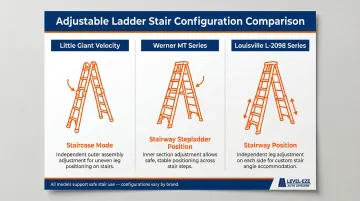
- Little Giant Velocity: Uses "Staircase" mode — adjust outer assemblies independently to fit the staircase while keeping rungs level
- Werner MT Series: Uses "Stairway Stepladder" position — lower one side of the inner section until the desired step height is reached
- Louisville L-2098 Series: Uses "Stairway" position with independent leg adjustment
Initiating Use
With the ladder configured, carry it to the staircase and position:
- Shorter leg on the higher stair tread
- Longer leg on the lower tread
This orientation compensates for the step height difference and allows the ladder to sit level side-to-side.
Before placing any weight on the rungs:
- Test stability by pressing down firmly on the top of the A-frame with both hands while keeping both feet on the ground
- The ladder should not rock, slide, or shift
- If it does, re-examine leg length settings and surface contact before proceeding
Confirm that both sets of feet are making full contact with the tread surface and are not hanging over an edge. The feet should sit flat and centered on the tread, with the ladder positioned as close to the wall as the task allows for added lateral support.
Operating Correctly
Climb safely:
- Climb slowly and centrally
- Maintain three points of contact at all times (two hands and one foot, or two feet and one hand)
- Avoid carrying tools or materials in your hands while climbing; use a tool belt or bucket hook instead
Maintain balance:
- Keep your body centered between the rails
- Avoid leaning sideways past the rail edges
- On a staircase, the open space at the side of the ladder feels deceiving — overreaching laterally is a leading cause of tip-over
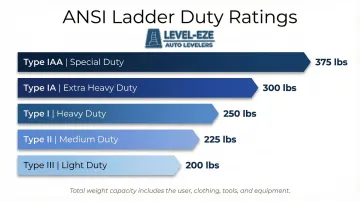
Staying centered also means staying within your ladder's load limits. ANSI duty ratings apply to the combined weight of the user, clothing, protective equipment, tools, and supplies:
- Type IAA (Special Duty): 375 lbs
- Type IA (Extra Heavy Duty): 300 lbs
- Type I (Heavy Duty): 250 lbs
- Type II (Medium Duty): 225 lbs
- Type III (Light Duty): 200 lbs
Never exceed your ladder's maximum working height or weight rating.
Repositioning Safely
Always descend fully before repositioning. Never attempt to "walk" or shift the ladder while standing on it — even slight lateral movement from an elevated position can cause the uneven legs to shift off their tread contact points on a ladder positioned on stairs.
After each repositioning:
- Repeat the ground-level stability test (hands on top, both feet down, press firmly) before climbing again
- This adds seconds to the task but is the single most effective check against unexpected movement mid-climb
Common Staircase Jobs That Call for an Adjustable Ladder
Typical residential and commercial tasks requiring ladder access on stairs:
- Painting stairwell walls and ceilings
- Changing high-mounted light fixtures or smoke detectors above a landing
- Hanging or adjusting artwork on a tall stairway wall
- Accessing a loft hatch above a staircase
- Performing trim or crown molding work at ceiling height over stairs
The stakes are higher in professional trade work. In electrical, HVAC, and telecommunications installation, stairwell access is a recurring challenge where the right ladder configuration directly affects both job completion speed and safety. Installation, maintenance, and repair occupations accounted for 5,790 nonfatal ladder injuries in 2020, with construction and extraction occupations adding another 5,370. Many of those injuries occurred in environments like stairwells, where uneven footing puts ladder stability at its greatest risk.
Best Practices for Staying Safe on Stairs
Using an adjustable ladder on stairs is manageable when you follow the right sequence. These habits take less than a minute each but prevent the most common causes of stair-related ladder accidents.
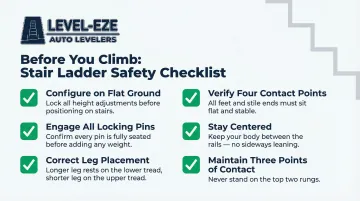
Before you climb, run through this checklist:
- Configure and lock leg heights on flat ground before moving the ladder to the stairs — adjusting while on stair treads creates instability
- Confirm both locking pins or locking mechanisms are fully engaged before applying any weight
- Position the ladder so the longer leg sits on the lower tread and the shorter leg sits on the upper tread
- Check that all four contact points (two feet, two rails or stile ends) are stable before ascending
- Keep your body centered between the rails — avoid leaning sideways to reach
- Never exceed the top two rungs; maintain three points of contact at all times
Set up, then step back and look. Before climbing, stand a few feet away and visually confirm the ladder is plumb (not tilting left or right) and that neither leg is rocking. A ladder that wobbles even slightly on flat ground will be far less forgiving on stairs.
Move the ladder, don't stretch. Overreaching is one of the leading causes of ladder falls. If you can't comfortably reach your work area without leaning beyond your belt buckle, descend and reposition. On stairs, repositioning takes an extra minute — a fall takes much longer to recover from.
If you're working on stairs regularly, a ladder leveler like those from Level-EZE eliminates the guesswork of manual leg adjustment. The automatic locking mechanism engages with as little as 9 lbs of weight, so both feet stay on the ground and both hands stay on the ladder during setup — exactly where they should be.