Introduction
Ladder falls are among the most preventable causes of serious injury and death in both professional and residential settings. In 2020 alone, ladders were the primary source of 161 workplace fatalities and 22,710 nonfatal occupational injuries involving days away from work. On the consumer side, an estimated 227,000 emergency department-treated injuries occurred that same year.
Most of those incidents trace back to one avoidable mistake: climbing higher than the ladder can safely support.
Knowing where to stop isn't always intuitive. Most people only realize they've gone too high once their balance starts to fail. The rules differ by ladder type, but both stepladders and extension ladders have clear, standards-backed answers that can prevent serious injury or death.
TL;DR
- Step ladders: never stand higher than two steps below the top
- Extension ladders: the highest safe standing level is the fourth rung from the top
- Follow the 4-to-1 rule for setup — one foot of base distance per four feet of ladder height
- Maximum safe reach is approximately four feet above your standing level
- Base stability matters as much as standing height — uneven ground shifts your ladder's safe working range
Highest Safe Standing Level on a Step Ladder
A step ladder is a self-supporting, hinged, non-adjustable ladder with a spreader mechanism that locks the front and back sections in place. Every step ladder manufactured in the United States must display a "highest standing level" label on its side rail, a standardized safety designation required by ANSI A14 standards.
The 2-Step Rule Explained
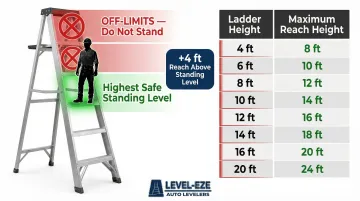
The highest safe standing level on a step ladder is two steps down from the top. The top cap and the step immediately below it are strictly off-limits for standing, per ANSI A14 standards and all major manufacturers including Werner, Louisville, and Little Giant.
Why this rule exists:
- Above the second-to-last step, there are no side rails at shoulder height to grip
- Your center of gravity shifts forward and sideways with no structural support to compensate
- A sideways tip or backward fall becomes likely, not just possible
- The labeled highest standing level is approximately 2 feet or more below the top cap
That labeled level is the benchmark from which maximum work height is calculated. Standing higher might gain you a foot of reach—but it removes the only support keeping you balanced.
Step Ladder Reach Guide
Standing height is capped by the 2-step rule, but total reach adds roughly 4 feet on top of that—based on a person around 5'6"–5'7" with a 12-inch overhead reach. Use the table below to select the right ladder for the height you need to access.
Step Ladder Reach Reference:
| Ladder Height | Maximum Reach Height |
|---|---|
| 4 ft | 8 ft |
| 6 ft | 10 ft |
| 8 ft | 12 ft |
| 10 ft | 14 ft |
| 12 ft | 16 ft |
| 14 ft | 18 ft |
| 16 ft | 20 ft |
| 18 ft | 22 ft |
| 20 ft | 24 ft |
Source: Werner Step Ladder Reach Guide
If you need to reach 12 feet, select an 8-foot step ladder. If you need 16 feet of reach, choose a 12-foot ladder. Never compensate for insufficient ladder height by standing above the safe level.
Highest Safe Standing Level on an Extension Ladder
Extension ladders work differently than step ladders. They're non-self-supporting, lean-to designs that adjust in length and depend on a top support point and a level, angled base. These design differences shift where the safe standing limit falls.
The 4-Rung Rule for Extension Ladders
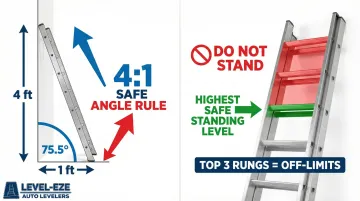
The highest safe standing level on an extension ladder is the fourth rung from the top. The top three rungs are never to be climbed or stood on. Safety standards require this limit to be marked on the ladder's label.
Why the 4-rung rule matters:
- At the top rungs, there's no rung above to grip for upper-body support
- You have nothing above to grip if you start to tip
- Any sideways shift or gust of wind at that height has no recovery option
- A single misstep leaves you with no way to recover your footing
The 4-to-1 Rule and Proper Setup Angle
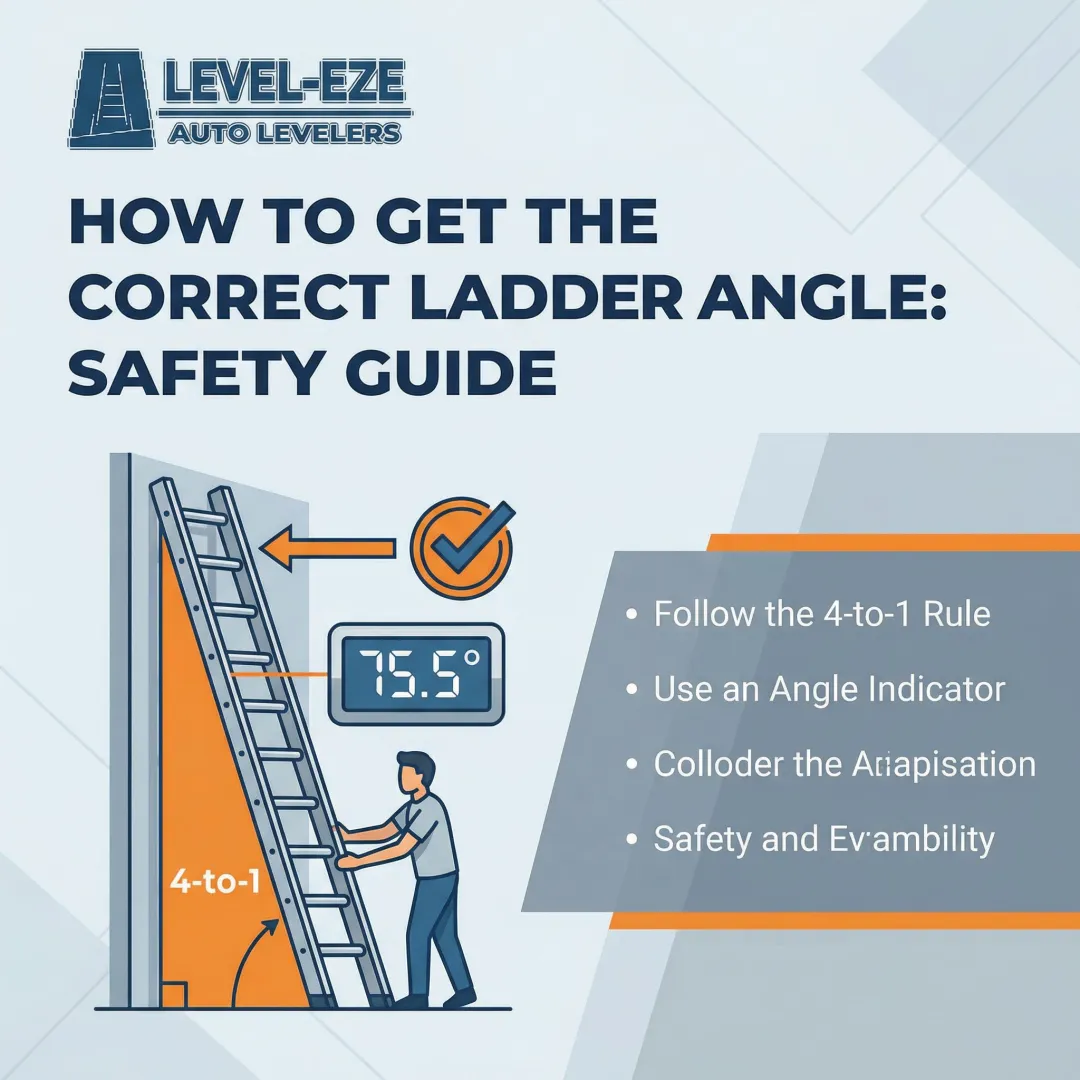
OSHA legally requires a 4-to-1 setup ratio: the base of the extension ladder must be placed one foot away from the wall or support surface for every four feet of working ladder height. This produces an angle of approximately 75.5 degrees, which is the optimal pitch for strength, stability, and climber balance.
Getting the angle wrong has real consequences:
- Too steep: The ladder kicks away from the wall under your weight
- Too shallow: The base slides out, especially on smooth surfaces
- Both failures get worse the higher you climb
Extension ladders should be selected so they are 7 to 10 feet longer than the highest contact or support point. This accounts for the overlap of sections, the 4-to-1 angle setback, and the standing level restriction below the top rungs.
Extension Ladder Reach Reference:
| Ladder Height | Maximum Reach Height |
|---|---|
| 16 ft | 15 ft |
| 20 ft | 19 ft |
| 24 ft | 23 ft |
| 28 ft | 27 ft |
| 32 ft | 31 ft |
| 36 ft | 34 ft |
| 40 ft | 37 ft |
| 48 ft | 45 ft |
Source: Werner Extension Ladder Reach Guide
Use this table to size up before you buy — most people underestimate how much the setup angle and standing restrictions cut into usable reach.
How Uneven Ground Affects Safe Standing Height
All safe standing level rules—for both step and extension ladders—assume the ladder base is on flat, stable, level ground. When terrain is uneven, the effective angle changes, the base can rock or shift, and the forces acting on the climber at height become unpredictable. A user standing at the "correct" level on a tilted ladder is still at elevated risk.
NIOSH reports that in about 40% of cases, the cause of a ladder-related injury is the ladder sliding out at the base from an incorrect setup angle.
Common improvised solutions—and why they fail:
- Propping one rail with a block creates unpredictable load distribution
- Digging out one foot changes the effective ladder length and angle
- Having someone hold the base relies on human strength and attention
- All methods introduce variables that compromise the engineered safety margin
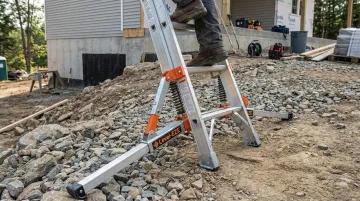
None of these workarounds reliably restore the stable base that safe standing height rules depend on. Automatic ladder levelers solve this at the source. Level-EZE by Jershon Inc. installs permanently on the extension ladder base, automatically adjusting on steps, slopes, curbs, and uneven terrain without manual setup or improvised supports.
Level-EZE meets ANSI standards for portable extension ladders and has been tested by Underwriters Laboratories at four times the ladder load rating. The base conditions that make safe standing level rules actually work are maintained automatically, even on challenging terrain.
Common Ladder Safety Mistakes to Avoid
Standing Above the Labeled Highest Standing Level
This is the single most common ladder fall trigger. Users reaching for just one more inch of height routinely step onto the top cap of a step ladder or the top rung of an extension ladder—exactly where balance can no longer be supported. The result is a lateral or backward fall from significant height with no way to recover.
Overreaching from a Valid Standing Level
Even when standing at the correct rung or step, leaning your body past the side rails to extend horizontal reach shifts your center of gravity beyond the ladder's support footprint.
A simple check: keep your belt buckle between the side rails at all times while climbing and working. If you can't reach your work area without leaning out, move the ladder instead.
Ignoring Base Surface Conditions Before Climbing
Slippery, soft, or uneven ground under the ladder feet can cause sudden base movement mid-climb. This is especially dangerous when you're already at the highest permitted standing level, where any shift in the base immediately compromises balance with no handhold above.
Check these conditions before you step on the first rung:
- Inspect the ground surface for level, stable footing
- Check for ice, mud, gravel, or other unstable materials
- Verify the ladder feet are making full contact with the surface
- On uneven terrain, use engineered leveling solutions, not improvised blocks
Conclusion
Safe standing level rules come from ladder geometry, body mechanics, and decades of fall incident data. Knowing where to stop is one of the few risk factors entirely within your control — so it's worth getting right every time.
Treat pre-climb setup as non-negotiable routine before every climb:
- Check the standing level label for your specific ladder type
- Set the correct angle (1:4 ratio for extension ladders)
- Confirm base stability — especially on uneven or sloped surfaces
These steps take seconds. A ladder leveler like Level-EZE handles the last point automatically, removing the guesswork from base setup entirely. The injuries they prevent don't.
Frequently Asked Questions
How high can you safely stand on a ladder?
The safe standing height depends on the ladder type: two steps below the top for step ladders, and the fourth rung from the top for extension ladders, as defined by ANSI standards and all major manufacturers.
What is the highest safe standing level on a step ladder?
The highest standing level is two steps down from the top—at least 2 feet below the top cap. The top cap and the step directly below it are never to be stood on.
What is the highest safe standing level on an extension ladder?
The fourth rung from the top is the maximum—the top three rungs are off-limits for standing. This limit must be labeled on the ladder per safety standards.
What is the 4-to-1 rule for extension ladders?
For every four feet of ladder height, the base must be placed one foot away from the wall. This produces a safe working angle of approximately 75.5 degrees.
How high can you reach with different ladder heights?
Maximum reach is roughly 4 feet above the highest standing level for an average adult. A 6-foot step ladder allows about 10 feet of reach, and longer extension ladders scale proportionally from there.
What ladder height do I need to reach 25 feet?
A 28-foot extension ladder provides approximately 27 feet of maximum reach at the correct setup angle, making it suitable for reaching 25 feet with a safe margin.