Introduction
In 2020, the Bureau of Labor Statistics recorded 161 fatal work injuries and 22,710 nonfatal injuries where ladders were the primary source. Metal roofs make those numbers worse. Their surfaces introduce hazards that asphalt shingles and flat roofs simply don't:
- Low-friction coatings that reduce grip even when dry
- Sloped profiles and raised seams that shift a ladder's contact points
- Moisture retention with no visible warning sign
- Thermal expansion that can move a ladder's position mid-job
OSHA explicitly warns that metal roofs become "particularly slippery when wet" — and that risk doesn't disappear when the sun comes out.
This guide walks through every step of stabilizing a ladder on a metal roof: ground setup, proper angle, securing methods, climbing behavior, and environmental hazards to watch for.
TL;DR
- Inspect your ladder for damage, clean feet, and confirm weight capacity before each use
- Apply the 4:1 angle rule and extend the ladder at least 3 feet above the roof edge
- Secure both the base and top—never rely on the metal surface alone
- Use non-slip accessories at the base and standoffs at the top to prevent lateral shift
- Never work during wet, frosty, or high-wind conditions
Why Metal Roofs Demand Extra Ladder Caution
Metal roofs present unique hazards that distinguish them from shingles or flat surfaces. Premium metal finishes are chemically similar to non-stick coatings, making them naturally slippery even when dry. Add condensation, frost, or rain, and the surface becomes nearly frictionless.
Pitch variation adds another layer of risk. Low-slope commercial roofs range from 1/4:12 to 3:12, while residential standing-seam installations often exceed 4:12. Each pitch creates different contact points where the ladder meets the roof — raised seams, panel ribs, and ridge lines all interfere with stable placement.
The panel material itself creates a third concern. Steel, aluminum, and copper panels dent or deform under point loads from ladder rails. Improper placement damages the roof and exposes you to liability — making correct tip positioning non-negotiable.
Safety Guidelines for Ladder Use on Metal Roofs
Safe ladder use on metal roofs requires attention at every stage: before you climb, during the ascent, and while you work at height. No single accessory replaces disciplined setup. Getting it right means choosing the correct ladder, setting the proper angle, and anchoring it consistently every time.
General Safety Precautions
Inspect before every use:
- Check for bent or cracked rungs, damaged feet, and slippery residue
- A compromised ladder should never be used where rescue access is difficult
- Remove oil, mud, or frost from rungs and feet
Confirm duty rating capacity. ANSI ladder duty ratings include the combined weight of climber, clothing, PPE, tools, and materials:
- Type IAA: 375 lbs (Special Duty)
- Type IA: 300 lbs (Extra Heavy Duty)
- Type I: 250 lbs (Heavy Duty)
OSHA recommends Type IA or Type I for professional roofing work, as these ladders sustain at least four times the maximum intended load.
Clear the landing zone at the base of debris, tools, and obstructions before setup. Falls from metal roofs are more likely to result in serious injury than falls from the same height on softer ground.
Setting Up Your Ladder Safely
Choose the right ladder type. Extension ladders are standard for metal roof access and must extend at least 3 feet beyond the eave line. This overhang provides safe handholds during roof transitions and dismounts.
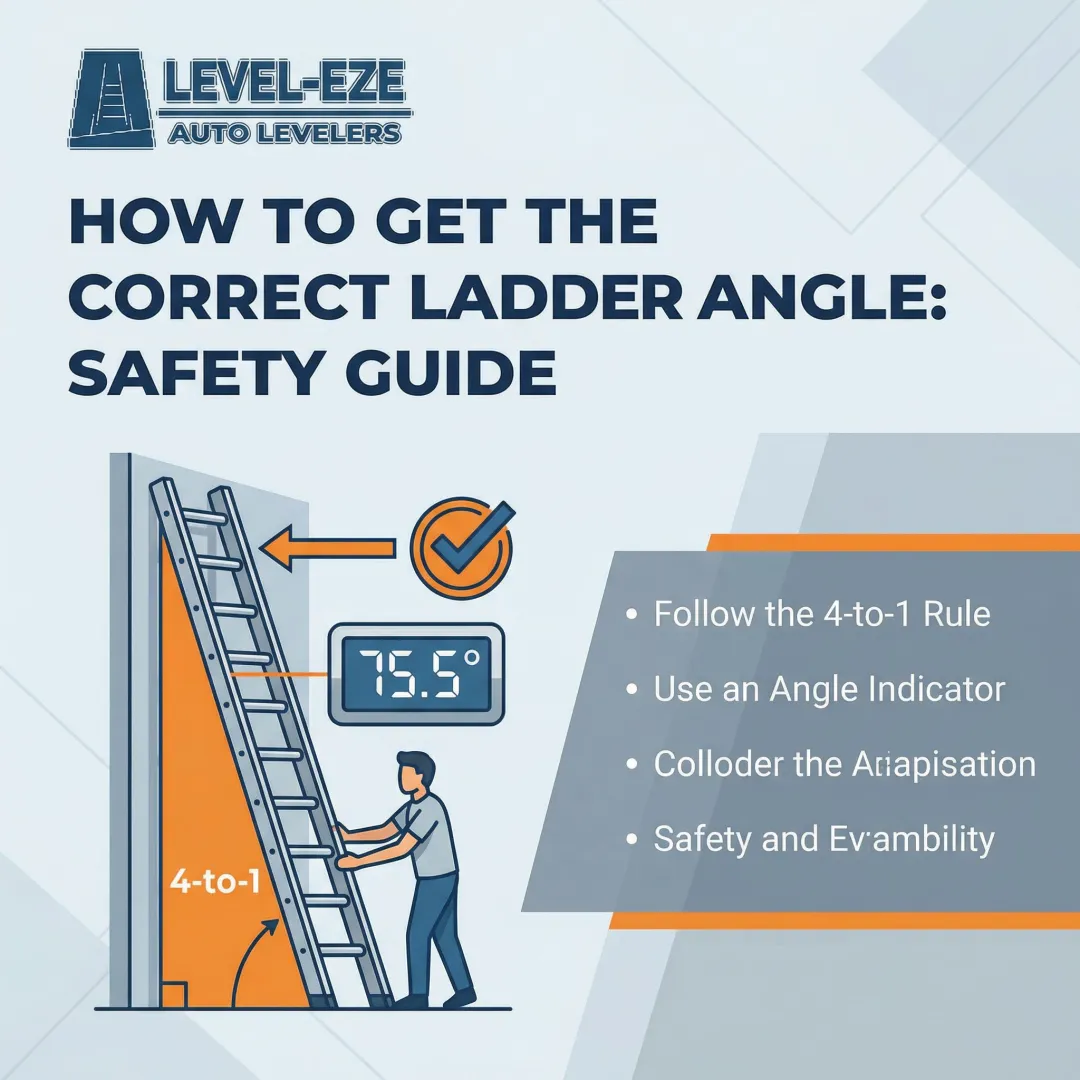
Apply the 4:1 pitch rule. OSHA mandates that for every 4 feet of vertical height, the base must sit 1 foot away from the structure (creating a 75.5-degree angle). To calculate:
- Measure the vertical height to the roof edge
- Divide by 4
- Position the base that distance from the wall
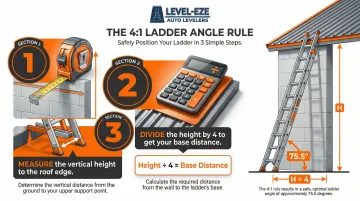
Example: For a 20-foot height, place the base 5 feet from the structure.
Address base stability on uneven ground. Commercial buildings, outbuildings, and agricultural sheds often sit on sloped or soft terrain. Use leveling boards, ladder leveler accessories, or automatic levelers to eliminate tilt without manual shimming. Level-EZE automatic ladder levelers, for instance, widen the base by approximately 4 inches, lock automatically under as little as 9 lbs of weight, and meet full ANSI standards — no tools or manual adjustment needed.
Position the ladder top carefully:
- Never rest rails directly against metal panels
- Use ladder standoffs, V-shaped stabilizers, or rubber-padded hooks
- Distribute load across a wider area to prevent denting or gutter compression
Anchor the base:
- Drive ground stakes or tie to a fixed anchor point where possible
- Use non-slip ladder feet rated for hard surfaces
- Add a secondary anchor if working on compacted dirt, gravel, or pavement
Climbing and Working Safely on a Metal Roof
Maintain three points of contact throughout ascent and descent—two hands and one foot, or two feet and one hand. OSHA requires at least one hand grasping the ladder when moving up or down. Never carry tools in your hands; use a tool belt, bucket hook, or rope hoist instead.
Face the ladder at all times. Leaning sideways or overreaching shifts your center of gravity and is a leading cause of lateral tip-overs.
Confirm dry metal panels before transitioning. Choose footwear with a dynamic coefficient of friction (DCOF) of 0.40 or higher on wet surfaces, meeting ASTM F3445-24 slip-resistance standards. Look for roofer-specific boots with non-slip, puncture-resistant soles.
Limit movement once on the roof:
- Stay low on the roof pitch
- Step only on structural supports (purlins or trusses beneath panels)
- Use a rope-and-harness fall arrest system for any pitch above 4:12 — OSHA requires fall protection for employees on steep roofs at 6 feet or more above lower levels
Weather and Environmental Safety Considerations
Watch for moisture at all times. Metal roofs retain moisture longer than shingles, and even light morning dew creates a nearly frictionless surface. Always perform a touch test before ascending and postpone work if panels show any wetness.
Account for thermal expansion. Dark-colored metal panels can reach 200°F in summer sun, then drop 25–30°F below ambient at night. That temperature swing causes significant panel expansion and contraction, which can shift a resting ladder unexpectedly. Check ladder contact points periodically during long jobs on hot days.
High winds pose greater risk on elevated metal roofs. OSHA advises suspending operations in bad weather, including high winds. While OSHA doesn't set a universal wind speed limit for all ladder work, consider postponing non-emergency work when winds exceed 30 mph.
Common Ladder Safety Mistakes on Metal Roofs
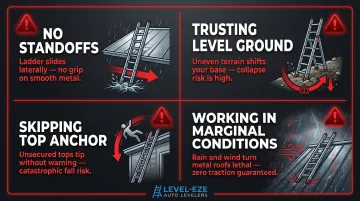
Most metal roof incidents trace back to the same handful of preventable errors. Watch out for these:
- No standoffs at the top. Smooth-coated metal offers zero lateral resistance — even minor loading shifts cause the ladder to slide sideways along the panel.
- Trusting the ground looks level. A 2-3% grade at the base creates enough lean to destabilize a tall extension ladder. This catches workers off guard on paved commercial aprons and compacted gravel alike.
- Skipping the top anchor. Metal panels flex, gutters crush under point loads, and surface contact alone won't hold. A physical anchor or standoff is non-negotiable.
- Working in marginal conditions. Rain, wind, or early morning frost may feel manageable when a deadline looms. The cost of a delay is a fraction of what a fall injury costs in lost workdays, workers' comp, and liability claims.
Conclusion
Every fall on a metal roof traces back to a setup decision made before the first step. Ground contact, angle, anchoring, footwear — each one either builds stability or undermines it.
Whether you're a contractor, utility worker, or homeowner, treat each step in this guide as non-negotiable. Invest in purpose-built accessories — automatic levelers like those from Level-EZE, standoffs, slip-resistant footwear — rather than improvised fixes. The right equipment doesn't just make the job easier; it removes the variables that cause accidents.
Frequently Asked Questions
Can you lean a ladder directly against a metal roof panel?
No. Resting ladder rails directly on metal panels risks lateral slippage and panel damage. Always use standoffs or padded stabilizers to distribute load and create stable contact points that won't slide or dent the surface.
What is the correct angle for a ladder on a metal roof?
Follow the 4:1 rule: place the base 1 foot away for every 4 feet of height (75.5 degrees). The ladder must extend at least 3 feet past the eave for safe roof access and dismount.
How do I stop my ladder from slipping on a metal roof?
Use non-slip rubber feet at the base, ladder standoffs or V-hooks at the top, and anchor the base to a fixed point. Avoid wet or frosted metal surfaces — grip disappears fast.
Do I need a spotter when using a ladder on a metal roof?
Yes — a spotter at the base is strongly recommended for any extension ladder work on a roof. OSHA ladder safety standards require spotters in many professional work environments, and having one significantly reduces risk during setup and dismount.
What type of ladder is best for accessing a metal roof?
Extension ladders are the standard choice. Choose Type IA (300 lbs) or Type I (250 lbs) duty ratings for professional use, and confirm the ladder clears the roofline by at least 3 feet.
How does weather affect ladder safety on a metal roof?
Metal surfaces become extremely slippery when wet, dewy, or frosted. Thermal expansion on hot days can also shift ladder positioning unexpectedly. Avoid working in any of these conditions — reschedule rather than risk it.