
Introduction
Falls from portable ladders remain a persistent and deadly hazard in occupational settings. According to the Bureau of Labor Statistics' 2024 Census of Fatal Occupational Injuries, fatal falls, slips, and trips totaled 844 in 2024, with ladder-related incidents representing a significant portion of these fatalities.
The scale of this problem extends beyond fatalities. In 2020 alone, there were 22,710 workplace injuries from ladders, contributing to an estimated $24 billion annual economic cost when factoring in work loss, medical expenses, and legal liability.
Step ladders are among the most commonly misused ladder types on jobsites. Their A-frame design feels inherently stable, but that same design creates strict surface requirements that workers frequently overlook. Placing a step ladder on uneven ground is a leading contributor to tip-over incidents, yet many workers assume "close enough" is sufficient.
Understanding where step ladders fail on uneven surfaces, and what ANSI standards and OSHA regulations actually require, is the difference between a near-miss and a fatality.
TLDR
- Step ladders require all four side rails in full contact with level ground — that's a structural design requirement, not a loose guideline
- Uneven surfaces create lateral tipping risks that improvised fixes like blocks or shims cannot correct
- If the ground can't be made genuinely level, relocate the ladder or switch to an extension ladder with a leveling accessory
- Always verify anti-slip feet are intact and spreaders fully locked before climbing
- Automatic ladder levelers — like Level-EZE — adjust instantly on slopes and uneven terrain without setup time or manual shimming
Why Step Ladders Are Not Designed for Uneven Surfaces
The A-Frame Structural Reality
Step ladders distribute user weight across four contact points: two front side rail feet and two rear side rail feet. The entire A-frame system is engineered assuming these four points sit on the same horizontal plane—level ground. When even one foot is elevated or unsupported, weight distribution shifts asymmetrically, spreaders come under uneven lateral stress, and the ladder's center of gravity moves toward the elevated side.
The American Ladder Institute explicitly states: "A Stepladder requires level ground support for all four of its side rails. If this work site condition does not exist, the Stepladder configuration should not be selected for the job." This isn't overcautious—it reflects the physics of the A-frame design.
What the Regulations Actually Say
OSHA's Construction standard (29 CFR 1926.1053(b)(6)) requires that "Ladders shall be used only on stable and level surfaces unless secured to prevent accidental displacement." General Industry standards (29 CFR 1910.23(c)(4)) repeat this requirement nearly word for word. These are enforceable regulations backed by real physics, not bureaucratic caution.
The Physics of Lateral Tipping
Research shows that stepladders most often lose stability by tipping sideways, not forward or backward. When one or more feet are elevated, the center of pressure shifts away from the ladder's geometric center. As the user reaches or leans, forces under the two feet diverge, pushing that center toward the ladder's edge. Once it passes outside the base, the ladder tips and the user falls.
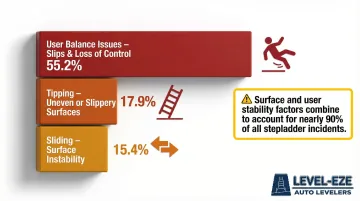
A follow-back study of emergency department cases broke down the causes of stepladder incidents:
- Tipping (uneven/slippery surfaces): 17.9% of incidents
- Sliding (surface instability): 15.4% of incidents
- User balance issues (slips, trips, loss of control): 55.2% of incidents
Surface and user stability factors together account for nearly 90% of stepladder falls.
Extension Ladders: A Better Choice for Uneven Ground
Those numbers make one thing clear: surface conditions are a primary driver of stepladder accidents. Extension ladders reduce that risk by requiring only two ground contact points, making them far more adaptable to field terrain. The American Ladder Institute notes that "unlike a stepladder that requires level support for all four of its side rails, the Extension Ladder requires only two level ground support points in addition to a top support. Ladder levelers may be used to achieve equal rail support on uneven surfaces."
For professionals who routinely encounter slopes, curbs, and uneven terrain, equipping extension ladders with a purpose-built automatic leveler like Level-EZE provides a safer, ANSI-compliant alternative to forcing a step ladder onto unsuitable ground. These devices automatically adjust for height differences up to 9.5 inches, ensuring both rails maintain equal ground contact without improvised supports.
Safety Guidelines for Step Ladder Use on Challenging Terrain
Safety on uneven terrain starts before the first rung is climbed. Pre-use decisions about site selection and ladder condition are as critical as behavior while climbing.
General Precautions Before You Set Up
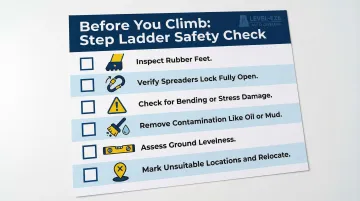
Before placing the ladder, inspect the equipment and the ground:
- Confirm rubber feet are intact — not cracked, missing, or caked with debris
- Check that spreader/brace mechanisms fully lock open
- Look for bending or stress damage on metal components
- Remove any contamination (oil, grease, mud) that reduces traction
- Use a level tool or visual check to assess ground levelness — slight cross-slopes invisible to the naked eye can destabilize an A-frame
- Mark unsuitable locations and find better placement nearby
Safe Setup and Placement
Once you've confirmed the ground conditions, how you position the ladder matters just as much.
If the ground can't be leveled at your chosen location, move the ladder — don't improvise. Bricks, lumber scraps, or stacked materials under individual feet create unstable pivot points and are no substitute for a true level surface. Aftermarket ladder leveling accessories, such as automatic levelers, are the designed solution for uneven terrain when relocation isn't practical.
The same rule applies vertically: never place a step ladder on boxes, scaffolding components, or vehicle beds to gain extra height. OSHA explicitly prohibits placing ladders on unstable bases to obtain additional height. The ladder must stand on the ground surface itself.
Safety While Climbing and Working
With the ladder properly positioned, follow these rules from the first step to the last:
Three-point contact:
- Two hands and one foot, or two feet and one hand, on the ladder at all times
- Use a tool belt or haul line instead of carrying materials while ascending
- Never rush or skip rungs
Body positioning:
- Keep your belt buckle within the width of the ladder frame
- Reaching outside the side rails shifts weight laterally and amplifies tipping risk
- Descend and reposition rather than leaning to extend reach
Height limits:
- Do not stand on the top cap, top step, or the step immediately below the highest permitted level
- Check the specifications label for your ladder's maximum standing height
Surface-Specific Hazards: What "Uneven" Looks Like in the Field
Not all uneven ground looks the same, and each surface type creates a different failure mode. Knowing what you're dealing with before you set up matters.
Slopes and Gradients
Even a modest cross-slope—ground that tilts side-to-side relative to the ladder's front face—places the A-frame under diagonal stress. This diagonal instability is more dangerous than a front-to-back lean because it's harder to detect visually before causing a tip-over. Workers often perceive forward/backward slopes but miss lateral tilts entirely.
Curbs, Doorsteps, and Elevation Transitions
When one pair of feet sits on a raised surface (a curb edge, for example) and the other pair sits lower, the ladder is immediately out of specification. Spreader tension becomes uneven, with one side compressed and the other stretched. This asymmetric loading creates a failure point, because the spreaders are not designed to handle this stress pattern. The ladder becomes unstable even if it initially feels solid.
Soft or Compressible Ground
Mud, wet soil, and grass may appear level at setup, but individual feet can sink at different rates as load is applied and shifted during use. This creates progressive instability that develops after the user is already elevated.
What felt solid on the first step can become dangerously unbalanced by the third or fourth as one or more feet settle unevenly into soft ground.
Wet, Icy, or Contaminated Surfaces
Anti-slip feet depend on friction. They are not effective on ice, frost, grease, or wet smooth surfaces. OSHA requires suitable means to prevent slipping before use under these conditions, and in most cases, a step ladder should not be used without a fully stable, dry surface beneath all four feet. Waiting for conditions to improve or relocating to treated ground is safer than attempting to work on slick surfaces.
Common Safety Mistakes to Avoid
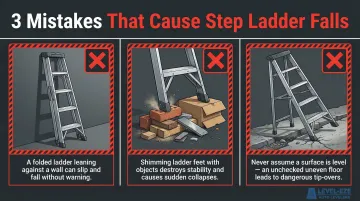
Three mistakes account for the majority of step ladder incidents on uneven ground. Each one feels like a reasonable shortcut in the moment — none of them are.
Leaning a folded step ladder against a wall. Step ladders are not designed or tested for leaning use. This removes two of the four ground contact points and places structural stress on the spreaders in a direction they aren't built to handle. If the job requires leaning, use an extension ladder properly secured at the top.
Shimming the short leg with blocks, bricks, or cardboard. This widely practiced workaround creates a pivot point, not a stable base. The improvised support can shift or compress under load, leaving the foot elevated rather than in continuous contact with a flat surface — exactly the instability you were trying to fix.
Assuming the surface is "flat enough" without checking. Construction sites, residential yards, utility right-of-ways, and rooftops all have variations that aren't visible during a casual walk-through but are enough to destabilize a loaded ladder. The gap between "looks fine" and "meets the standard" is where most incidents happen. Verify level before you climb — every time.
Conclusion
Step ladder limitations on uneven surfaces are not overcautious rules—they reflect the structural geometry of the A-frame design, which only performs safely when all four feet are in full, equal contact with a level surface. The solution is not to improvise around the limitation but to select the right tool for the terrain.
Workers and safety managers should treat surface assessment as a non-negotiable part of every ladder setup, not an afterthought after the ladder is already in position. When jobs routinely involve uneven ground, equip teams with the right alternatives. Extension ladders fitted with automatic leveling accessories like Level-EZE, which adjust instantly and lock with as little as 9 lbs of pressure, provide a safer, ANSI-compliant solution for terrain that step ladders simply cannot handle.
If the ground isn't level and you can't make it level, don't use a step ladder. Use equipment built for the conditions you're actually working in.
Frequently Asked Questions
What are the limitations of a step ladder on uneven surfaces?
Step ladders require all four side rail feet to contact level ground simultaneously per ANSI and OSHA requirements. Uneven surfaces compromise the A-frame's weight distribution and create a lateral tipping risk that cannot be safely corrected with blocks, shims, or other improvised solutions on site.
What ladder is best for uneven ground?
Extension ladders are better suited for uneven terrain because they only require two ground contact points and work with ladder levelers to achieve equal rail support. With the right leveling equipment, they can safely adapt to slopes, curbs, and uneven terrain where step ladders cannot.
What are the OSHA requirements for step ladders?
Under 29 CFR 1926 Subpart X, OSHA requires that step ladders meet these conditions:
- Placed only on stable, level surfaces
- Spreaders fully locked before use
- Top step and top cap not used as standing surfaces
- Rated to sustain at least four times the maximum intended load
- Defective ladders tagged "Dangerous: Do Not Use" and removed from service immediately
What are the common ladder safety rules (angle, three points of contact)?
Always maintain three-point contact (two hands and one foot, or two feet and one hand) and keep your body centered between the side rails. Step ladders don't follow an angle rule, but must be fully open with spreaders locked on a level surface.
Can you stand on the top step of a step ladder?
No. Standing on the top step, top cap, or pail shelf is prohibited by ANSI standards and OSHA regulations. The highest permitted standing level is marked on the ladder's specifications label and is typically two or more steps below the top to maintain safe balance and center of gravity.