Introduction
Ladder safety training levels refer to the tiered system of knowledge, skills, and responsibilities that OSHA and ANSI use to classify who can use, supervise, and make decisions about ladder safety on the job. This framework ensures workers possess the competency required for their specific role—from basic safe use to engineering-level decision-making.
This guide is written for safety managers, contractors, utility workers, and professional tradespeople who need a clear breakdown of each level—who it applies to, what it covers, and what it requires in practice.
Given that ladders caused 161 workplace fatalities and 22,710 injuries in 2020, understanding these distinctions isn't academic—it's essential for compliance and worker safety.
TL;DR
- Ladder training has distinct competency tiers—from basic authorized users to qualified persons—each with specific responsibilities under OSHA
- OSHA mandates employer-provided training under 29 CFR 1910.30 (general industry) and 29 CFR 1926.1060 (construction)
- Ladder duty ratings (Type III through Type IAA) define load capacity — trained workers must apply this when selecting the right ladder for the job
- Training requirements depend on job role, work environment, and task complexity—not employer preference alone
- Retraining is mandatory when unsafe practices are observed, conditions change, or standards update
What Are Ladder Safety Training Levels?
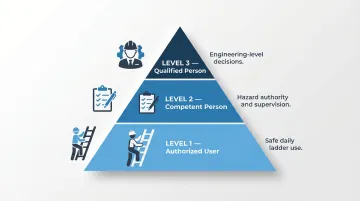
Ladder safety training levels refer to a competency hierarchy used by OSHA and industry standards. Three distinct tiers define what a worker is trained and authorized to do:
- Authorized users follow established safe-use procedures on the job
- Competent persons identify hazards, take corrective action, and can train others
- Qualified persons apply specialized knowledge to engineering-level decisions — structural anchorage, non-standard applications, and ladder safety system design
Why the Distinction Matters
This hierarchy differs fundamentally from ladder duty ratings (Type I, II, III), which describe a ladder's load capacity, not a worker's training tier. Professionals need fluency in both systems—confusing them creates compliance gaps and increases injury risk.
Assigning a task requiring a competent person to an authorized user violates OSHA standards and exposes workers to preventable hazards. With ladders ranking #3 on OSHA's most cited violations for fiscal year 2025 (2,405 citations), this distinction matters operationally and legally.
The Three OSHA-Recognized Training Levels Explained
Level 1 — Authorized Ladder User
This baseline level covers:
- Recognizing fall hazards in the work environment
- Choosing the correct ladder type for the specific task
- Conducting pre-use inspections for defects or damage
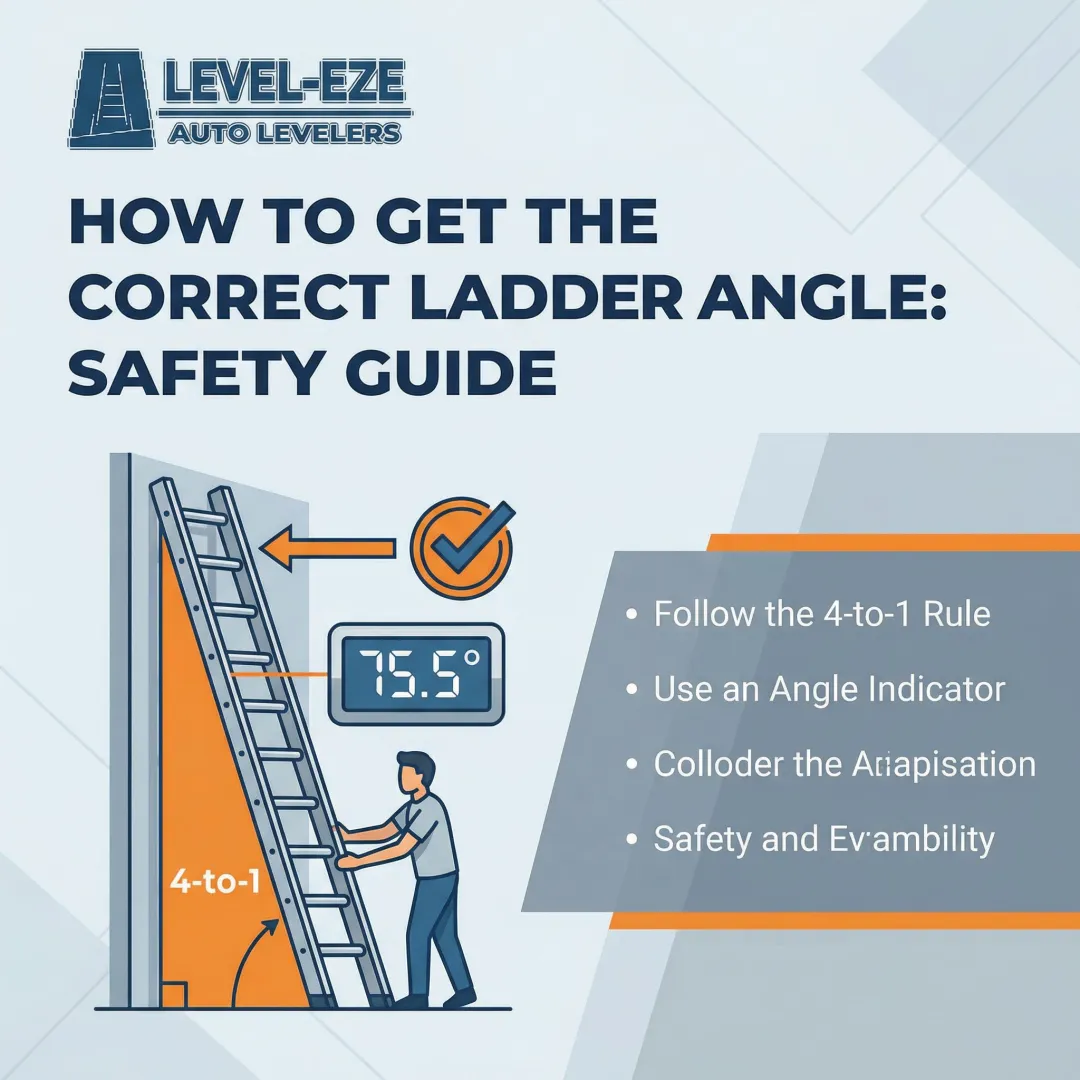
- Setting up ladders per manufacturer instructions, including the 4-to-1 rule for extension ladders (1 foot out for every 4 feet up)
- Maintaining three points of contact during ascent and descent
This level is required for any worker who uses a ladder on the job. OSHA 1910.30 and 1926.1060 both mandate this training be delivered by a qualified or competent person—not self-administered through online modules alone.
What authorized users cannot do:
- Make decisions about fall protection system selection
- Modify ladder setups for non-standard surfaces or conditions
- Supervise or train other workers on ladder use
- Remove equipment from service or approve complex setups
Level 2 — Competent Person
The competent person standard defined in 29 CFR 1926.32(f) describes someone who can identify existing and predictable ladder hazards, has authority to take prompt corrective measures, and has the knowledge and training to do so.
This is the level required to train others, conduct site inspections, and approve ladder use in complex environments.
Competency training adds:
- Hazard assessment methodology for job sites
- Fall protection system selection, inspection, and validation
- Authority to correct unsafe setups or remove equipment from service
- Knowledge to train and supervise authorized users
Employers often require this level for lead workers, foremen, and safety supervisors on sites where crews use ladders regularly. Unlike authorized users, competent persons carry regulatory authority to make binding safety decisions.
Level 3 — Qualified Person
Some situations go beyond what a competent person is authorized to handle—structural anchor design, non-standard configurations, or company-wide program development. That's where the qualified person tier applies.
Per OSHA's definition in 29 CFR 1926.32(m), a qualified person has a recognized degree, certificate, or professional standing—or has demonstrated the ability to solve problems in the subject matter through extensive knowledge and experience.
Examples of qualified person responsibilities:
- Engineering-level assessments of fall protection anchor points
- Designing custom ladder access solutions for complex structures
- Signing off on modifications to standard ladder configurations
- Developing company-wide ladder safety programs and policies
Most field professionals operate at Level 1 or Level 2. The qualified person designation typically applies to safety engineers, professional consultants, and those setting policy—not workers managing daily ladder use on site.
Ladder Duty Ratings and Their Role in Training Requirements
Duty ratings classify a ladder's load capacity, not the worker's training level. Knowing how they interact is what drives correct equipment selection on the job.
The five ANSI-defined duty rating levels:
| Type | Duty Classification | Maximum Load | Intended Use |
|---|---|---|---|
| Type IAA | Special Duty | 375 lbs | Heavy industrial |
| Type IA | Extra Heavy Duty | 300 lbs | Industrial |
| Type I | Heavy Duty | 250 lbs | Industrial |
| Type II | Medium Duty | 225 lbs | Commercial |
| Type III | Light Duty | 200 lbs | Household |
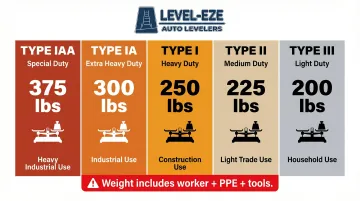
When applying these ratings, trained workers must account for their own weight plus PPE, tools, and materials — not body weight alone. A 180-pound worker carrying 50 pounds of tools requires at minimum a Type I ladder (250-pound capacity).
Connection to Training
A competent person is responsible for ensuring workers select duty-rated ladders appropriate for the task. Authorized users must be trained to read and apply duty rating labels, but the competent person validates the selection decision in high-risk environments.
A 2017 Massachusetts FACE investigation documented a fatal fall where a worker weighing 350–400 pounds used a Type IA ladder rated for only 300 pounds — a preventable overload. Authorized user training must include hands-on recognition of duty rating labels and a clear understanding of what exceeding load limits does to structural integrity.
Grade 2 and Grade 3 Terminology
Some international and ANSI contexts use "Grade" terminology rather than "Type." Grade 3 equals Type III light-duty; Grade 2 equals Type II medium-duty. In U.S. professional settings, OSHA and ANSI use "Type" ratings exclusively. Workers on global job sites or handling imported equipment should confirm which system applies before selecting a ladder.
Factors That Determine Which Training Level You Need
Training level requirements aren't uniform across industries. Construction (1926.1060) and general industry (1910.30) have different regulatory structures. Specialized sectors like utilities, telecommunications, and industrial maintenance often layer additional employer or sector-specific requirements on top. Safety managers should audit their applicable standard before building a training program — the environmental conditions on a job site often push requirements higher than the baseline.
Conditions that escalate training tier requirements:
- Uneven or sloped terrain
- Rooftop access points
- Work adjacent to confined spaces
- High-traffic pedestrian or vehicle areas
- Surfaces with grade changes or unstable footing
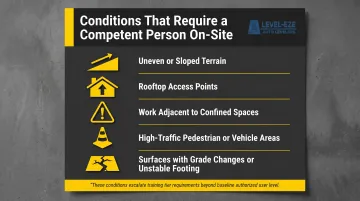
These conditions require at minimum a competent person on site. Training covers awareness and technique, but setup errors on uneven ground are a separate problem.
For professionals who regularly work on slopes, curbs, or rooftop access points, automatic leveling equipment eliminates the variables training alone can't control. The Level-EZE automatic ladder leveler meets ANSI standards and is used by utilities, telecom technicians, and contractors to remove manual leveling errors on challenging terrain.
Retraining Triggers
OSHA requires retraining when:
- An employee demonstrates unsafe behavior or lack of proficiency
- Work conditions change (new surfaces, heights, or hazards)
- New ladder types are introduced to the worksite
- Standards or procedures are updated
Safety managers should document both initial training dates and retraining events. Missing retraining records are among the most cited ladder-related findings in OSHA inspections — and one of the easiest compliance gaps to close with consistent documentation practice.
Common Misconceptions About Ladder Safety Training Levels
"Any Ladder Course Makes You a Competent Person"
This is the most damaging misconception. Under OSHA's definition, competency means a demonstrated combination of knowledge, training, and recognized authority — not a certificate. Passing a 30-minute online module does not automatically meet the competent person standard.
OSHA explicitly states that online-only training without hands-on components and access to a qualified trainer does not satisfy training requirements.
Confusing Duty Ratings with Training Levels
Many professionals refer to "Type I training" or "Grade 2 certification," conflating the ladder's structural classification with the worker's training tier. These are entirely separate systems. Treating them interchangeably leads to improper equipment selection and documentation errors.
"Initial Training Carries Indefinitely"
Many employers skip retraining, assuming initial training remains valid. OSHA explicitly requires retraining when workers demonstrate unsafe behavior or when job conditions change. Retraining triggers include:
- Observable unsafe ladder practices on the job
- New equipment, different work environments, or updated procedures
- Incidents or near-misses involving ladder use
This requirement appears in both 29 CFR 1910.30 and 29 CFR 1926.1060 — and OSHA compliance officers cite it regularly during inspections.
Frequently Asked Questions
What is the OSHA standard for ladder training?
OSHA covers ladder training under 29 CFR 1910.30 for general industry and 29 CFR 1926.1060 for construction. Both require employer-provided training by a qualified or competent person covering fall hazard recognition, proper ladder use, load capacity, and fall protection procedures.
What is a Grade 2 or 3 ladder?
"Grade" terminology comes from ANSI and international standards — Grade 3 maps to light-duty (Type III) and Grade 2 to medium-duty (Type II) in U.S. terms. Most domestic job sites use the OSHA/ANSI Type rating system, but professionals handling imported or internationally specified equipment may encounter Grade designations instead.
Who is allowed to use a Type III (Class 3) ladder?
A Type III ladder is rated for light-duty household use at a maximum of 200 pounds. It is not appropriate for professional or industrial job sites. Any worker using a ladder on a job site regulated by OSHA should select at minimum a Type I ladder (250-pound capacity) and complete authorized user training first.
What is a competent person in ladder safety?
OSHA defines a competent person as someone who can identify existing and predictable hazards and has authority to take corrective action — a mandatory role wherever ladder use involves fall hazards. Employers must ensure this designation is earned through training and demonstrated competency, not simply assigned by title.
How often does OSHA require ladder safety retraining?
OSHA does not specify a fixed retraining interval. Retraining is required whenever a worker demonstrates unsafe practices, when new ladder types or work surfaces are introduced, or when regulations change. Employers should document all retraining events as part of their compliance records.
What is the difference between an authorized user and a competent person for ladder safety?
An authorized user is trained to use ladders safely within defined conditions. A competent person goes further — they can assess hazards, correct unsafe setups, train others, remove equipment from service, and approve complex ladder configurations. That regulatory authority is what separates the two designations.