Introduction
In 2020, 161 workplace fatalities and 22,710 nonfatal ladder injuries occurred across U.S. workplaces, with construction and maintenance sectors bearing the highest burden. According to NIOSH research, approximately 40% of ladder-related injuries stem from the ladder sliding out at the base due to incorrect setup angle — a preventable error that costs employers an average of 8 missed workdays per incident.
Each incident also triggers liability exposure, workers' compensation claims, project delays, and increased insurance premiums — costs that add up fast for contractors and safety managers.
Most of those incidents trace back to fixable setup errors: wrong lean angle, uneven ground, or no base stabilization in place. This guide covers how to achieve the correct 4:1 angle, choose the right stabilizing accessories, and build a consistent setup protocol your crew can repeat on every job.
TL;DR
- Use the 4:1 ratio: for every 4 feet of working height, place the base 1 foot from the wall
- Ladders face two stability risks: lateral tip-over (sideways) and base slide-out (forward/backward)
- Wall stabilizers widen top contact and prevent sideways slip; base levelers correct uneven ground beneath the feet
- Inspect surfaces and overhead hazards before climbing, and confirm any stabilizing accessories are rated for your ladder type
- Conditions can change while you're working at height, so re-inspect whenever you reposition the ladder
What Is a Ladder Angle Stabilizer?
The term "ladder angle stabilizer" covers two distinct accessory types that address different failure points:
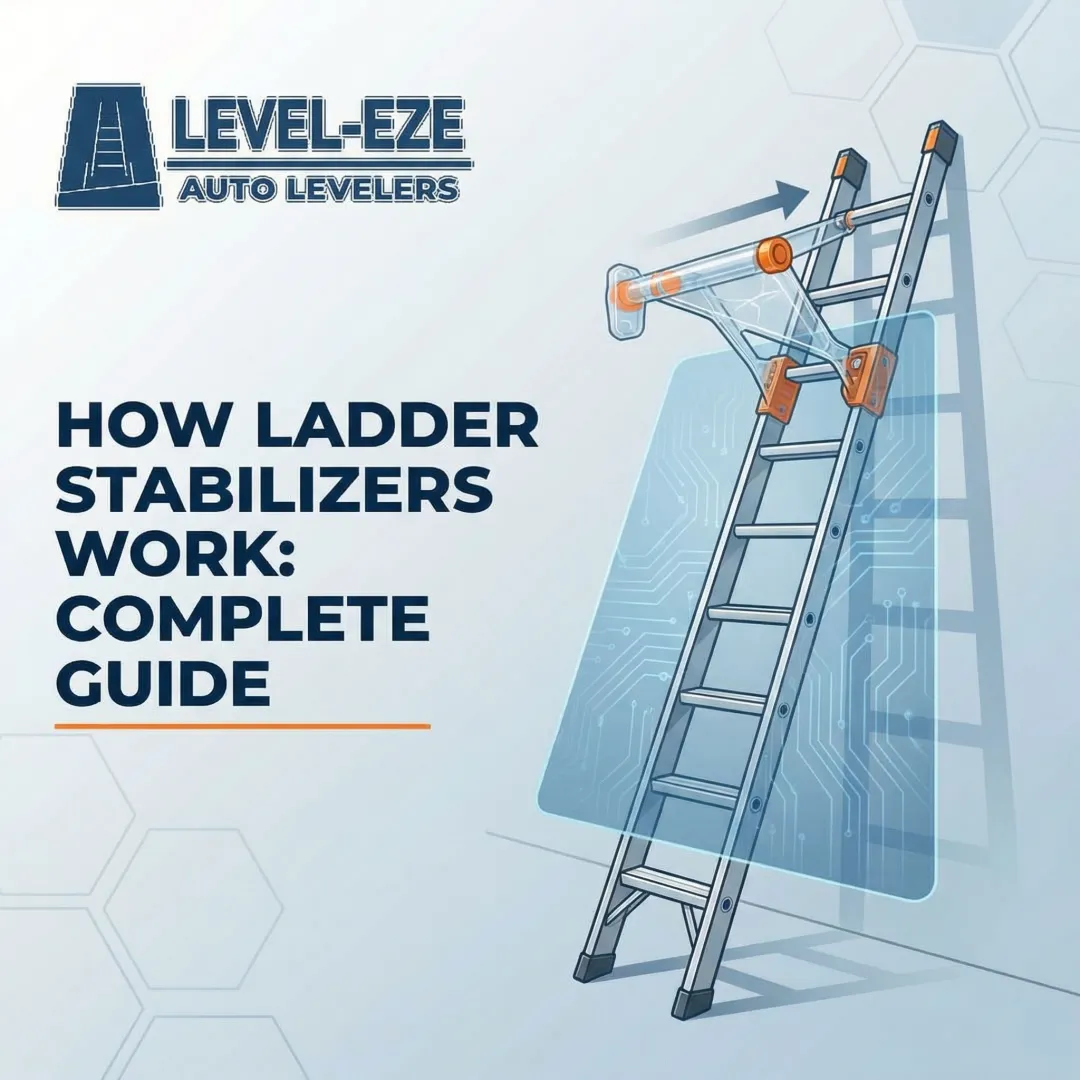
- Wall-mounted stabilizers create standoff distance from the building surface and widen the top contact area, preventing lateral slipping and protecting gutters from damage
- Base-level levelers correct for uneven ground beneath the ladder feet, eliminating manual shimming or digging on slopes, steps, or uneven terrain
Neither accessory alone guarantees safety. A properly set angle means nothing if the ground beneath one foot is six inches lower than the other. Similarly, a stable wall connection offers no protection if the base sits at 65 degrees instead of the required 75 degrees and begins to slide. Safety depends on both ends of the ladder working together.
Types of Ladder Stabilizing Accessories
Wall and roof stabilizers are tubular arms that mount near the ladder's top section and span outward from the wall. They widen the contact base, prevent lateral slipping against siding or brick, and protect gutters from scrapes. Fixed-depth models cover standard applications; adjustable versions handle window spans and varying wall conditions.
Automatic ladder levelers mount permanently at the base and self-adjust for uneven, sloped, or stepped terrain in seconds — no blocks, bricks, or digging required. Level-EZE's automatic leveler, for example, adjusts up to 9.5 inches and locks with as little as 9 lbs of weight. It meets ANSI standards, has been tested by Underwriters Laboratories at four times the ladder load rating, and works on stairs, curbs, slopes, and rooftops — with both hands on the ladder the entire time.
Why Proper Ladder Angle Matters for Safety
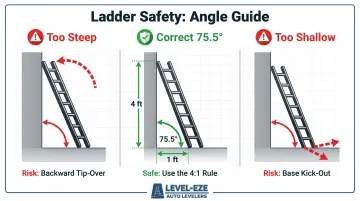
Incorrect lean angle — too steep or too shallow — shifts the ladder's center of gravity outside the safe zone, sharply increasing the chance of base slide-out or backward tipping. Biomechanical research shows that reducing the angle from 75° to 65° nearly doubles the friction required to prevent a slip. Yet field studies reveal workers average a 67.3° setup angle when relying on visual estimation — well below the 75.5° standard — because they lack feedback during setup.
The consequences of getting it wrong are predictable:
- Too steep (base too close to wall): The ladder can tip backward as you climb
- Too shallow (base too far out): Friction at the feet can't resist forward force, and the ladder kicks out mid-climb
- Either case: OSHA and ANSI mandate the 4:1 ratio specifically because deviations put the load path outside the stable zone
Safety Guidelines for Ladder Angle and Stabilization
Safe ladder use requires four aligned factors: correct lean angle, a stable and level base, appropriate stabilizing accessories, and behavioral discipline while working at height. These factors are environment-dependent—the same ladder safe on flat concrete becomes a hazard on wet grass, gravel, or a slope. Reassess stabilization needs every time you move the ladder.
General Safety Precautions
Personal Protective Baselines:
- Wear non-slip footwear with good tread
- Avoid carrying heavy loads while climbing—use a tool belt or haul line
- Maintain three points of contact at all times (two hands and one foot, or two feet and one hand)
- Never exceed the ladder's rated load capacity, including your body weight plus tools and materials
Workspace Readiness:
- Clear the area beneath and around the ladder of debris, cords, and trip hazards
- Check for overhead power lines before raising the ladder—electrocution is a leading cause of ladder fatalities
- Have a second person present when working at significant height or near electrical hazards
When to Stop and Re-Evaluate:
If wind picks up, if the ground shifts or softens, if the ladder wobbles during use, or if a stabilizer shows any movement, stop immediately. Each of these signals an active stability failure, not a minor inconvenience. Descend, re-inspect, and re-set before continuing.
Safe Setup: Applying the 4:1 Rule and Installing Stabilizers
Verify the 4:1 Angle:
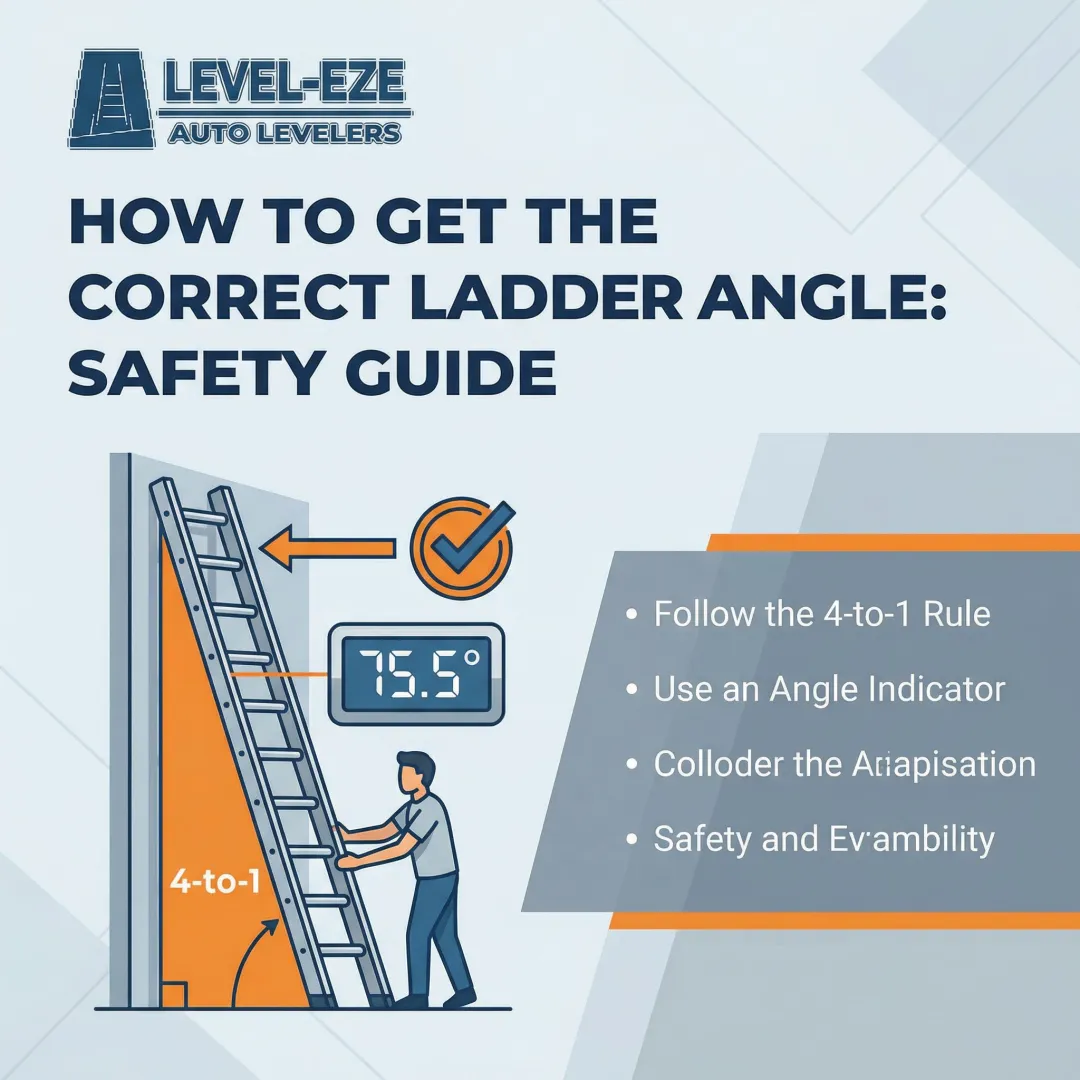
For every 4 feet of vertical height to the point of contact, place the base 1 foot away from the wall. This creates approximately 75.5 degrees of inclination. Use the "arm reach test" to verify without tools: stand at the base with toes against the ladder feet and extend your arms forward horizontally. If your hands comfortably reach the rung at shoulder height, the angle is approximately correct. Alternatively, use an angle indicator accessory for precision.
Inspect Surfaces Before Setup:
Watch for these common surface hazards before placing the ladder:
- Soft soil that will compress or shift under load
- Debris that creates an uneven or unstable base
- Wet or slick surfaces at the wall or ground contact points
- Drainage slopes that direct water beneath the feet
- Raised edges (like sidewalk lips) that prevent both feet from making full contact
Placing a ladder on unlevel ground without a leveling solution creates a compound risk—the ladder leans laterally even when the front-to-back angle is correct.
Install a Wall or Roof Stabilizer:
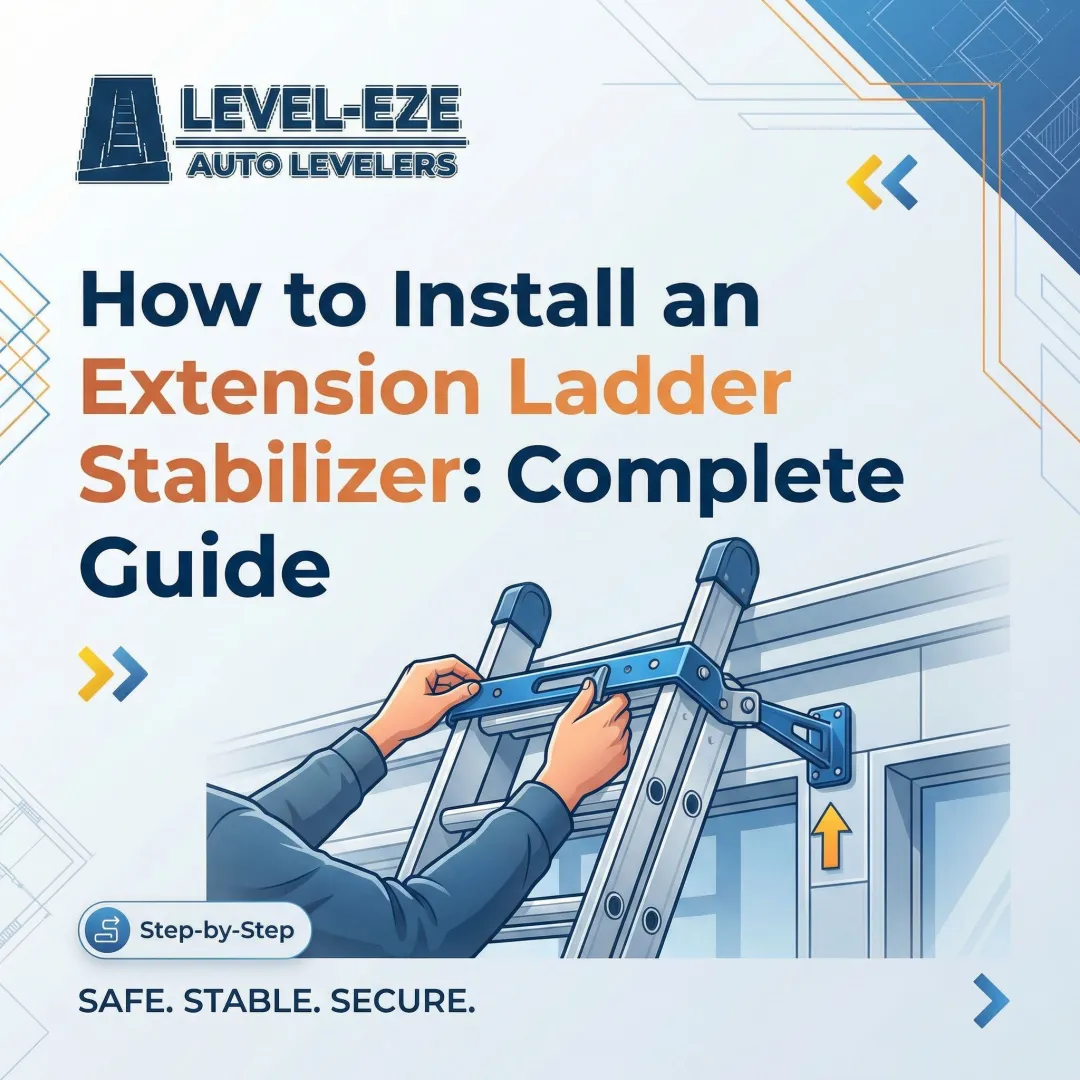
Position the stabilizer between the ladder and the surface so rubber pads contact the wall cleanly. Ensure U-bolts or mounting clips are locked and snug. Verify the stabilizer does not create a false sense of security that leads to overreaching—it widens your top support but does not eliminate the need to stay centered.
Use Base Levelers for Uneven Ground:
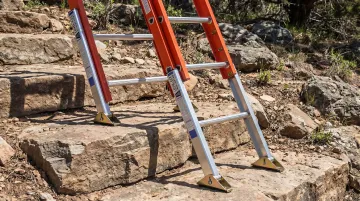
Level-EZE's automatic ladder leveler mounts permanently at the base and self-adjusts to terrain in seconds. It meets ANSI standards for portable extension ladders, has been tested at four times the ladder load rating, and works on steps, curbs, slopes, and rooftops while keeping both hands on the ladder and both feet on the ground during setup. It adds approximately four inches to the effective base width, improving stability even on level surfaces.
Confirm Compatibility:
Match the accessory to your ladder's material (aluminum vs. fiberglass) and duty rating (Type I, Type IA, Type IAA). Never use a stabilizer designed for folding stepladders on an extension ladder or vice versa—the load paths and attachment points differ.
Safety While Using a Stabilized Ladder
Operating Limits:
- Stay within the rated load—your weight plus tools and materials
- Keep your belt buckle centered between the rails (belt buckle rule)
- Never lean out beyond arm's reach—reposition the ladder instead
- Always face the ladder when climbing or descending
Behavioral Risks Stabilizers Can Mask:
A stabilized ladder creates a perception of extra security that sometimes leads to overreaching, carrying heavier tools, or skipping re-checks when conditions change. Stabilizers reduce one category of risk—lateral or base instability—but do not eliminate the need for behavioral discipline.
Warning Signals to Watch For:
- Visible wobble when shifting weight
- Audible creaking from a mounting connection
- One foot lifting off the ground
- Any movement of the stabilizer arms
Each of these requires stopping, descending, and re-setting before continuing.
Environmental and Surface Safety Considerations
Ground Conditions Affect Angle Stability:
Soft soil, gravel, wet grass, freshly laid asphalt, and uneven paving all undermine footing. A leveling device or stabilizer feet are appropriate when the surface is firm but uneven—steps, curbs, or minor slopes. If the ground is actively shifting, saturated, or crumbling, no accessory makes it safe; that surface is a no-go until conditions improve. OSHA 1926.1053(b)(6) requires ladders be used "only on stable and level surfaces unless secured to prevent accidental displacement."
Slope and Step Scenarios:
Working on a hillside, rooftop parapet, or stepped curb creates a lateral tilt that cannot be corrected by leaning the ladder at a different angle. This is where an automatic base leveler adds the most measurable value—Level-EZE's leveler self-adjusts the moment it contacts uneven terrain, saving an average of six minutes per repositioning and eliminating the manual balancing process that leaves you exposed during setup.
Weather and Visibility:
Wet surfaces reduce friction at both the base and the wall contact point. OSHA guidance states ladders "shall not be used on slippery surfaces unless secured or provided with slip-resistant feet." Wind above certain thresholds creates side-load forces that no standard stabilizer is rated for. When conditions are that poor, the right call is to stop work until they improve—no accessory substitutes for safe weather.
Common Safety Mistakes to Avoid
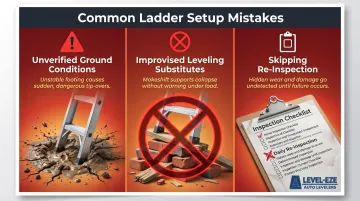
Even with the right equipment, setup errors cause most ladder incidents. These three mistakes show up repeatedly across job sites — professional and residential alike.
Unverified Ground Conditions
Workers often place a ladder on what looks like solid ground without physically testing it. A base that looks firm can sink or shift mid-climb, changing the angle without warning and causing the ladder to slide out.
Improvised Leveling Substitutes
Bricks, scrap wood, or folded cardboard create an unrated, inconsistent base that compresses or cracks under load. OSHA 29 CFR 1910.23(c)(13) explicitly prohibits placing ladders on boxes, barrels, or other unstable bases — a rule these improvised fixes routinely violate.
Skipping Re-Inspection Between Placements
A stabilizer does not make a ladder permanently safe at every new location. Each move is a fresh setup. Run the same ground and angle checks every time, regardless of how familiar the site feels.
Conclusion
Safe ladder use comes down to three factors working together:
- Correct lean angle — the 4-to-1 ratio keeps load forces within safe limits
- Stable, level base — uneven ground is one of the most common causes of tip-overs
- Appropriate stabilizing accessories — angle stabilizers, standoffs, and automatic levelers remove the human error from the steps most likely to fail
None of these can substitute for the others being neglected. Treat ladder setup as a repeatable, inspectable protocol rather than a quick judgment call. Automatic leveling accessories, in particular, eliminate guesswork on uneven terrain — the kind of adjustment that's easy to rush and costly to get wrong.
With the right equipment and consistent habits, ladder accidents are preventable. Every one of them.
Frequently Asked Questions
What is the 4:1 angle rule for a ladder?
For every 4 feet of vertical height, position the ladder base 1 foot out from the wall, creating approximately 75 degrees of inclination. This OSHA-recommended ratio prevents base slide-out and maintains a stable center of gravity during climbing and working.
What is a ladder angle stabilizer and how does it work?
A ladder angle stabilizer reduces the risk of tipping by improving contact and support at the ladder's most vulnerable points. Wall stabilizers widen the top contact area and prevent sideways slipping, while base levelers automatically adjust each leg so both feet sit flush on uneven terrain at the correct angle.
What is the difference between a ladder stabilizer and a ladder leveler?
A stabilizer addresses lateral stability at the top of the ladder, preventing sideways tipping against a wall. A leveler addresses vertical alignment at the base, compensating for uneven ground to keep both feet making full contact and maintaining the correct lean angle.
Can I use a ladder safely on uneven or sloped ground?
Yes — with the right equipment. A certified automatic ladder leveler adjusts each leg independently to match slopes, steps, curbs, and rooftops, eliminating the need for improvised shimming and keeping the ladder at the correct angle throughout.
How do I know if my ladder is positioned at the correct angle?
Stand at the base with toes against the ladder feet and extend your arms forward. If your hands comfortably reach the rung at shoulder height, the angle is approximately correct. An automatic leveler with a built-in locking mechanism, like the Level-EZE, removes the guesswork entirely by maintaining the correct base position on any surface.
What ANSI and OSHA standards apply to ladder stabilizers?
Ladder accessories including stabilizers should conform to ANSI ASC A14.8-2020 standards for ladder accessories. OSHA 29 CFR 1926.1053 governs ladder use in construction. Verify that any accessory is rated for your specific ladder type and load class.